Google Hands Marvell a $12.2 Billion Stake to Build Its Next AI Chips
News Summary
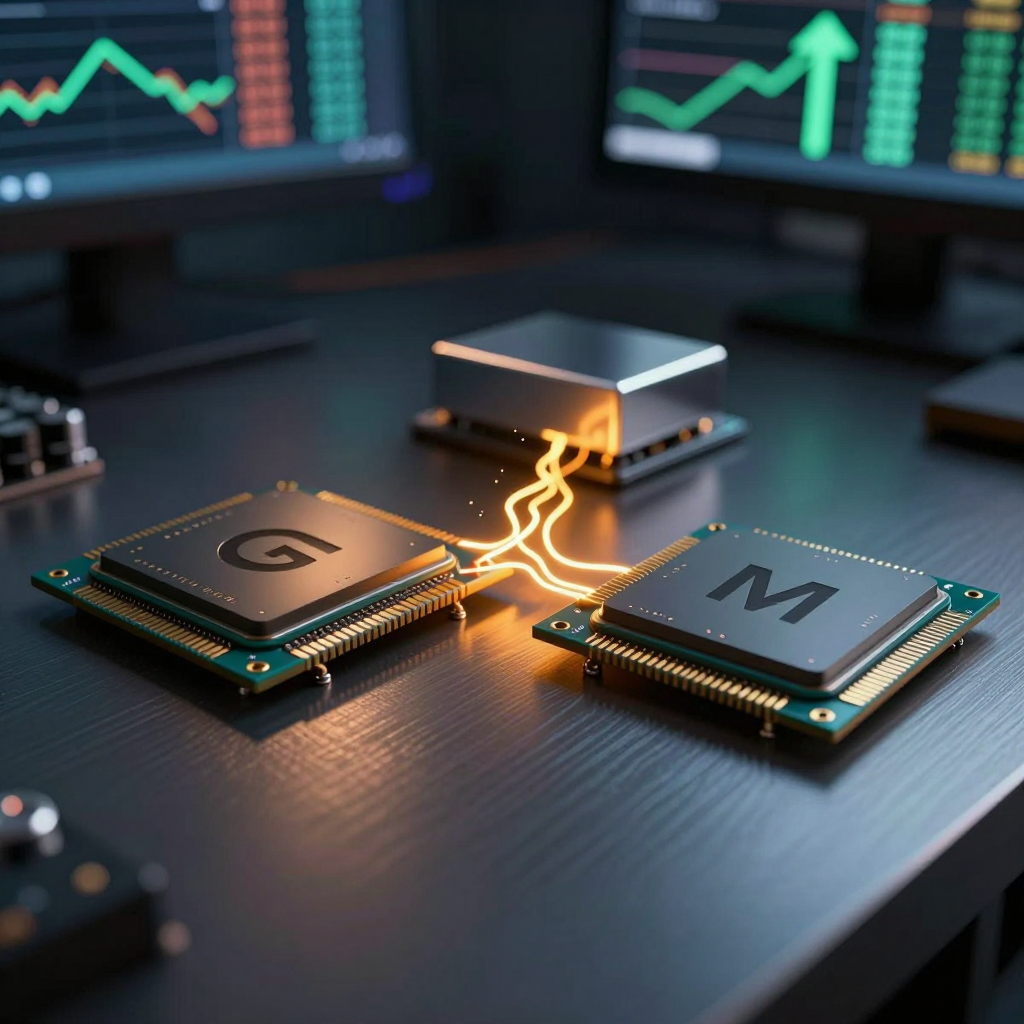
Google and Marvell Technology announced an expanded commercial agreement on August 18, 2026 (Eastern Time) that positions Marvell as a design partner across a broad slate of custom silicon tied to Google's Tensor Processing Unit ecosystem. As part of the deal, Marvell issued Google a warrant to purchase up to roughly 58.97 million Marvell shares — about 7.7% of the company — at an exercise price of $206.58 per share, an option worth up to $12.2 billion. Marvell shares jumped as much as 12% in premarket trading on August 19 following the announcement, before settling to a gain of roughly 10% during the session.
What the Partnership Covers
The agreement spans a wide range of custom chip programs that attach to Google's TPU ecosystem rather than a single product. According to the companies, the scope includes AI inference accelerators, storage controllers, network interface controllers, memory interface controllers, and near-memory compute devices. Industry reporting indicates the collaboration centers on two distinct chips: a Memory Processing Unit (MPU) designed to work alongside Google's existing TPUs, and a new inference-optimized TPU variant built specifically for AI inference workloads rather than model training.
Google has been diversifying its custom silicon supply chain as demand for AI compute continues to outpace available capacity. Broadcom remains Google's principal TPU manufacturing and design partner under an agreement that reportedly extends through 2031, so the Marvell deal is best understood as an expansion of Google's custom-chip roster rather than a replacement of its existing partnership.
Financial Structure of the Deal
The warrant Marvell issued to Google on August 18 vests in tranches tied to purchasing milestones: each $500 million in chip orders placed by Google unlocks an additional tranche of shares. Reports indicate the warrant could fully vest if Google's cumulative spending with Marvell reaches $120 billion by fiscal year 2033, a structure that ties Marvell's equity upside directly to the scale of Google's future orders rather than guaranteeing it upfront.
This type of equity-linked supply agreement has become more common in the AI infrastructure sector, where chip designers and cloud providers use warrants or purchase-linked equity stakes to align incentives over multi-year hardware roadmaps.
Market and Industry Context
The announcement caps what analysts describe as a sweep of custom AI silicon relationships across the three largest U.S. hyperscalers, with Marvell now holding design partnerships tied to Google, Amazon, and Microsoft. Custom AI accelerators, often called ASICs, have drawn increasing attention from cloud providers seeking lower-cost, workload-specific alternatives to general-purpose GPUs for large-scale inference, which is expected to make up a growing share of AI data center spending as more companies move from training frontier models to deploying them at scale.
Analysts covering the semiconductor sector noted that the deal reinforces Marvell's position in the custom silicon market alongside Broadcom, historically the dominant player in ASIC design for hyperscale cloud customers. Some analysis also pointed to contract chipmaker TSMC as a broader beneficiary of the expanded partnership, since both Marvell's and Broadcom's custom TPU-related designs are manufactured using TSMC's advanced process nodes.
What Comes Next
Neither company has published a detailed public timeline for when chips developed under the expanded agreement will enter production or deployment in Google's data centers. Investors and analysts are expected to look for further specifics, including production timelines and initial order volumes, in upcoming quarterly earnings calls from both companies.