Etched's Valuation Doubles to $21 Billion in Just One Month
News Summary
AI chip startup Etched has raised $700 million in new funding at a $21 billion valuation, more than doubling its worth in just one month after closing a $300 million round at $10.3 billion in late July 2026. The new round was led by quantitative trading firm Jane Street, which recently became Etched's first paying customer, with participation from existing backers including Sequoia Capital, Andreessen Horowitz, Kleiner Perkins, Tiger Global, Bain Capital Ventures, Neo, Stripes, Primary, Positive Sum, Diffusion, Argo, Peter Thiel, and Blackstone. The announcement, made on August 18, 2026 (Eastern Time), underscores how quickly investor appetite for specialized AI inference hardware has grown as demand for running large language models efficiently continues to outpace the supply of general-purpose GPUs.
From $5 Billion to $21 Billion in Eight Months
Etched's valuation trajectory has been unusually steep even by the standards of the current AI hardware boom. The Cupertino-based company, founded in 2021, was valued at roughly $5 billion in December 2025. By July 23, 2026, that figure had more than doubled to $10.3 billion following a $300 million Series C round led by Sequoia Capital, with Andreessen Horowitz, Jane Street, Diffusion, and SK Hynix also participating. Less than a month later, the valuation doubled again to $21 billion on the back of the new $700 million raise, adding nearly $11 billion in enterprise value in roughly four weeks. Company executives have attributed the accelerated fundraising pace to concrete performance validation from a real customer deployment rather than projections alone.
A Chip Built Only for Transformers
Etched's core product is Sohu, an application-specific integrated circuit (ASIC) that hardcodes the transformer architecture, the neural network design underlying nearly all modern large language models, directly into silicon. Unlike general-purpose graphics processing units, which must remain flexible enough to handle many types of computation, Sohu is purpose-built exclusively to run transformer-based inference workloads. The company says this specialization lets its math-optimized circuits operate at under half the voltage of typical AI accelerators while achieving higher floating-point operations (FLOPs) density, particularly for the dot-product calculations used in transformer attention mechanisms and the matrix multiplications common across large language model layers.
Beyond the chip itself, Etched has engineered a full "frontier inference cluster" system that pairs two custom components: a prefill chip tuned for the compute-intensive stage of inference, when a model processes an incoming prompt, and a cluster-scale memory system that lets multiple chips share memory at high speed and low latency during the decode stage, when a model generates output tokens one at a time. According to co-founder and Chief Operating Officer Robert Wachen, "Inference is built in two stages, prefill and decode," and Etched's architecture is designed to address the distinct compute and memory demands of each stage separately rather than relying on a single general-purpose design. The system also includes a proprietary interconnect that Etched says completes certain communication tasks in roughly 700 milliseconds, compared with around 4,000 milliseconds for competing chip architectures, along with custom cold plates and voltage regulator modules for thermal and power management. The first Sohu prototype was manufactured by Taiwan Semiconductor Manufacturing Co. (TSMC) in early 2026.
Jane Street Becomes the First Live Deployment
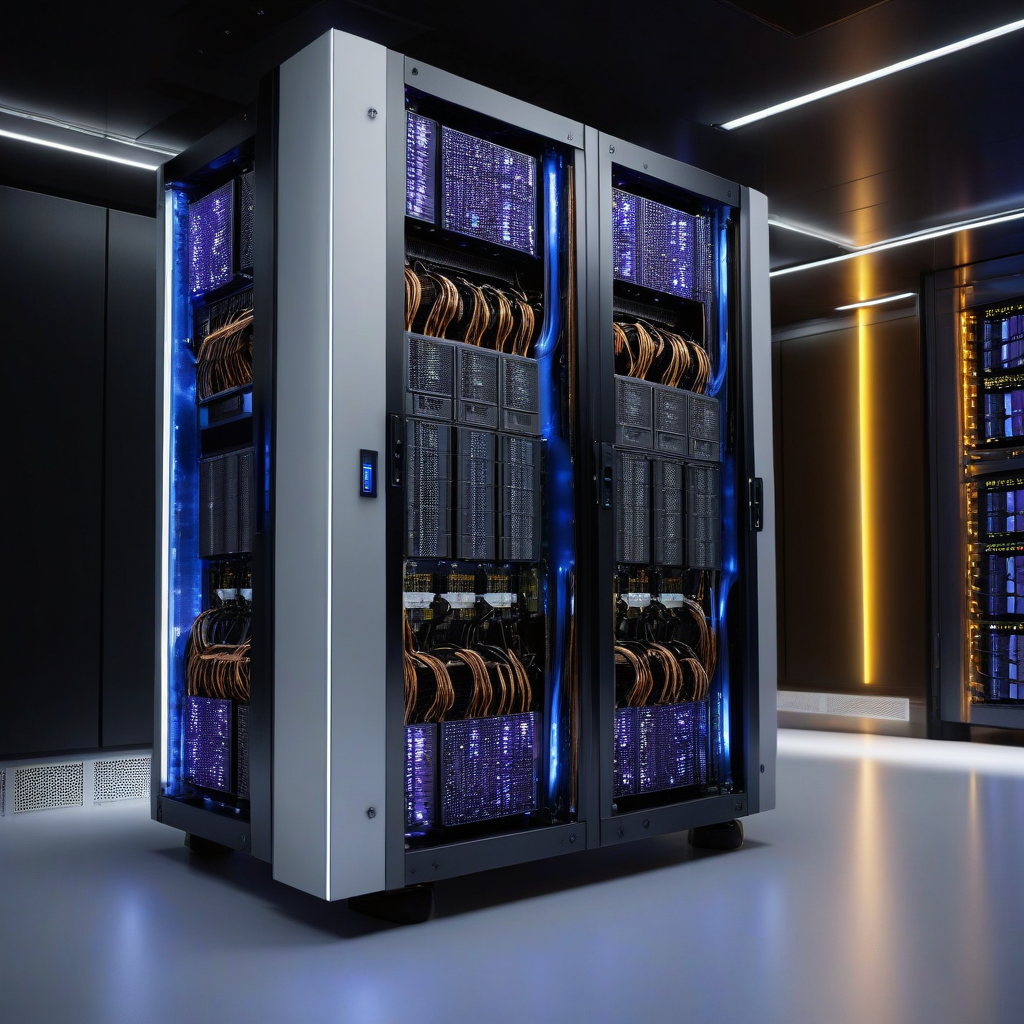
The centerpiece of the August funding announcement is Etched's completion of its first customer delivery: a rack of Sohu-based hardware installed and actively running inside Jane Street's own data center. Jane Street, known primarily as a quantitative trading firm, evaluated Etched's system on a 2-megawatt AI test cluster at Etched's San Jose headquarters before committing to deployment. In comments shared alongside the funding news, Jane Street said it "tested the chip and are pleased with the early results" and now operates its own rack in its data center, running production inference workloads on the hardware.
Etched CEO Gavin Uberti described the milestone in terms of engineering velocity, noting, "It took us three years to deliver our first rack from scratch. Our next one will be much faster." That comment reflects a broader argument the company has made to investors: that the hard, multi-year engineering work of building a working transformer-specific chip and system from the ground up is now behind it, and that subsequent deployments should scale faster as manufacturing and integration processes mature.
Competitive Landscape
Etched positions itself as a direct challenger to Nvidia, which continues to dominate the broader AI accelerator market with its general-purpose GPU lines. Etched has previously claimed that Sohu can outperform Nvidia's H100 GPUs by a wide margin on transformer-specific inference tasks, citing figures as high as a 20-times speed advantage in internal benchmarks, and the company says it has already booked more than $1 billion in signed customer contracts. Etched is one of a growing cohort of startups, alongside other AI chip designers pursuing specialized inference hardware, betting that as AI workloads shift from training new models toward running, or "inferencing," existing ones at massive scale, purpose-built silicon can outcompete general-purpose GPUs on cost and energy efficiency for that specific task.
Why It Matters
The rapid re-rating of Etched's valuation, doubling twice within roughly seven months, illustrates how intensely global investors are competing to back companies addressing the surging computational cost of AI inference. As more organizations worldwide move AI models from research and training into everyday production use, the efficiency of the hardware running those models has become a critical cost and performance factor for businesses, from financial firms to cloud providers. Etched's story, built around a real, revenue-generating deployment rather than speculative capacity, offers an early data point on how investors are weighing proven performance against forward-looking bets in the fast-evolving AI infrastructure market.