Stargardt Patient Reads a Word After Science Corp's PRIMA Chip Implant
News Summary
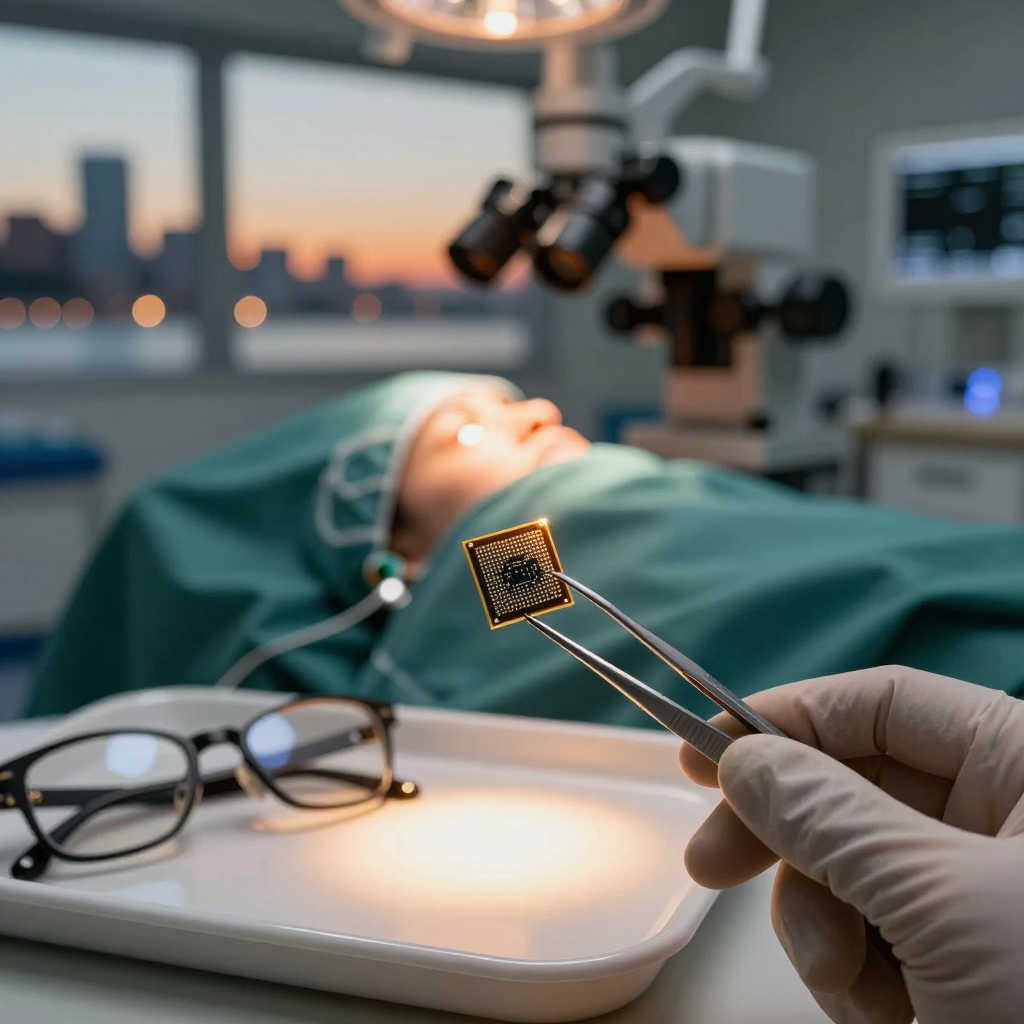
Science Corporation, the neurotechnology company founded by former Neuralink president Max Hodak, has implanted its PRIMA retinal chip in its first patient with Stargardt disease, an inherited condition that gradually destroys central vision. According to TechCrunch's report dated October 13, 2026 (calendar date, Eastern Time reference), the procedure took place in May 2026 at Sydney Eye Hospital in Australia as part of an ongoing trial. In the first rehabilitation session the patient saw a letter, and in the second the patient read a word.
What Happened
Hodak announced the milestone and discussed it onstage at TechCrunch Disrupt. The patient has Stargardt disease, which damages the outer retina, the layer containing light-sensing photoreceptor cells, and produces a central blind spot that grows over time. The implant was placed in May 2026, and the early rehabilitation results were shared in October 2026, roughly five months later.
Independent searches show a registered exploratory study (NCT07266584), sponsored by Science Corporation Australia, that is investigating whether people with inherited retinal degeneration affecting the macula, including Stargardt disease, can benefit from PRIMA. Reports have named Sydney Eye Hospital as the initial site, with Dr. Matthew Simunovic cited as a lead investigator. At the time of writing, we found no separate press release from the company or hospital confirming the first Stargardt implant, so the details here rest mainly on TechCrunch's account of Hodak's remarks.
How the PRIMA Device Works
PRIMA is a wireless photovoltaic chip measuring 2 mm by 2 mm. It is placed at the back of the eye, in the region where the natural photoreceptors have degenerated. The surgery takes about an hour.
Patients wear glasses with a built-in camera. The glasses capture the scene and send it, as light, to the chip, which converts it into electrical signals that stimulate the surviving inner retinal cells. In effect, the chip acts as a set of artificial photoreceptors. The inner retina and the optic pathway to the brain are often spared in Stargardt disease, which is why a retinal prosthesis can work at all. As Hodak put it, "The retina is part of the central nervous system."
The image the patient perceives is black and white and high contrast. Hodak described it as "like looking through a straw": the field of view is narrow, so a patient sees only a couple of letters at a time.
Why Stargardt Disease Matters
Stargardt disease is currently considered incurable. Roughly 150,000 people worldwide have lost vision to it, according to the figure cited by TechCrunch. It often begins earlier in life than age-related macular degeneration, so restoring even partial reading ability could have a large impact on education, work and daily independence.
Background: PRIMA in Europe
PRIMA is already commercially available in Europe for patients who have lost sight to geographic atrophy, an advanced form of age-related macular degeneration. Science Corporation announced the European launch in July 2026. The CE mark, issued by the notified body DEKRA under the EU Medical Device Regulation, covers 30 European countries. The company said it expected its first commercial implant in Germany in August, planned to treat dozens of patients this year and around 200 next year, and was working through reimbursement applications and clinical site activations country by country.
The main efficacy evidence is a clinical study published in the New England Journal of Medicine in 2025. One report summarizing it said the device improved vision in 26 of 32 patients with advanced age-related macular degeneration, helping them identify letters, numbers and words. The Stargardt work extends that approach to a different disease and a younger patient group.
What Comes Next
Hodak outlined two engineering priorities. The first is a wider field of view, which requires handling the curvature of the eye. The second is smaller electrodes, which would move the level of detail closer to natural vision. A next-generation device is expected in humans within about a year. Hodak predicted that over five years the technology could approach natural visual acuity. That is a forecast from the company's chief executive, not a demonstrated result.
Beyond the Eye: Brain-Computer Interface Plans
Hodak founded Science Corporation in 2021 after leaving Neuralink. The company began with advanced neural engineering and brain-computer interfaces (BCIs) and is restoring vision first to prove its methods and build a sustainable business. Its BCI sensor is designed to rest on the surface of the brain, inside the skull, rather than being inserted into brain tissue as Neuralink's devices are.
Near-term plans include a first clinical indication for a neurodegenerative disease that has not been named publicly, as well as possible stroke-related uses and monitoring neurological activity in brain tumor patients. Longer term, Hodak says the company wants to understand how the brain produces the mind. He believes many people will need some form of BCI by their 60s or 70s, and said the goal is to extend health span, not only lifespan, rather than to target healthy 40-year-olds.
Why It Matters
A single patient reading a word after two sessions is an early signal, not proof of benefit. The trial is exploratory, the sample is one person, and the vision provided is narrow and monochrome. Still, it shows that a technology proven in older adults with macular degeneration may be adaptable to inherited retinal disease, and it highlights the retina as a practical entry point for neural interface technology.
Sources: TechCrunch (October 13, 2026); Ophthalmology Times, New Atlas, MassDevice and EyeSmart coverage of the PRIMA European launch; Science Corporation's website and the NCT07266584 trial listing.
This article was compiled by the AIBARS editorial team with AI assistance. AI can make mistakes, so please check the original source for anything important. Spotted an error? Email [email protected].