Meta's 816-Billion-Parameter Muse Spark Open Runs on Two Mac Studios
News Summary
On October 15, 2026, Meta released Muse Spark Open, an open-weight AI model with roughly 816 billion total parameters that is designed to run locally on Apple's Mac Studio computers. Meta calls it the most capable open-weight model from a US developer to date, and says it is the first model of its size that can run on a pair of desktop machines rather than a data-center rack. TechCrunch published its report at 1:04 PM Pacific Time (PDT) that day.
What Meta Released
Muse Spark Open is a natively multimodal model built for complex coding and agentic tasks, meaning work in which an AI plans and carries out multi-step jobs with tools. TechCrunch reports a context window of 1 million tokens, which lets the model hold very large codebases or long documents in view at once.
Coverage from Tech Insider describes the architecture as a mixture-of-experts design. Only about 42 billion of the 816 billion parameters are active for any single token, and each layer has 256 experts, 8 of which are used per token. The model accepts text, images, audio and video as input and produces text as output.
Two checkpoints are listed: a full-precision BF16 version (Muse-Spark-Open-816B-A42B) and a lower-precision NVFP4 version intended to reduce the memory footprint.
How It Runs on a Mac
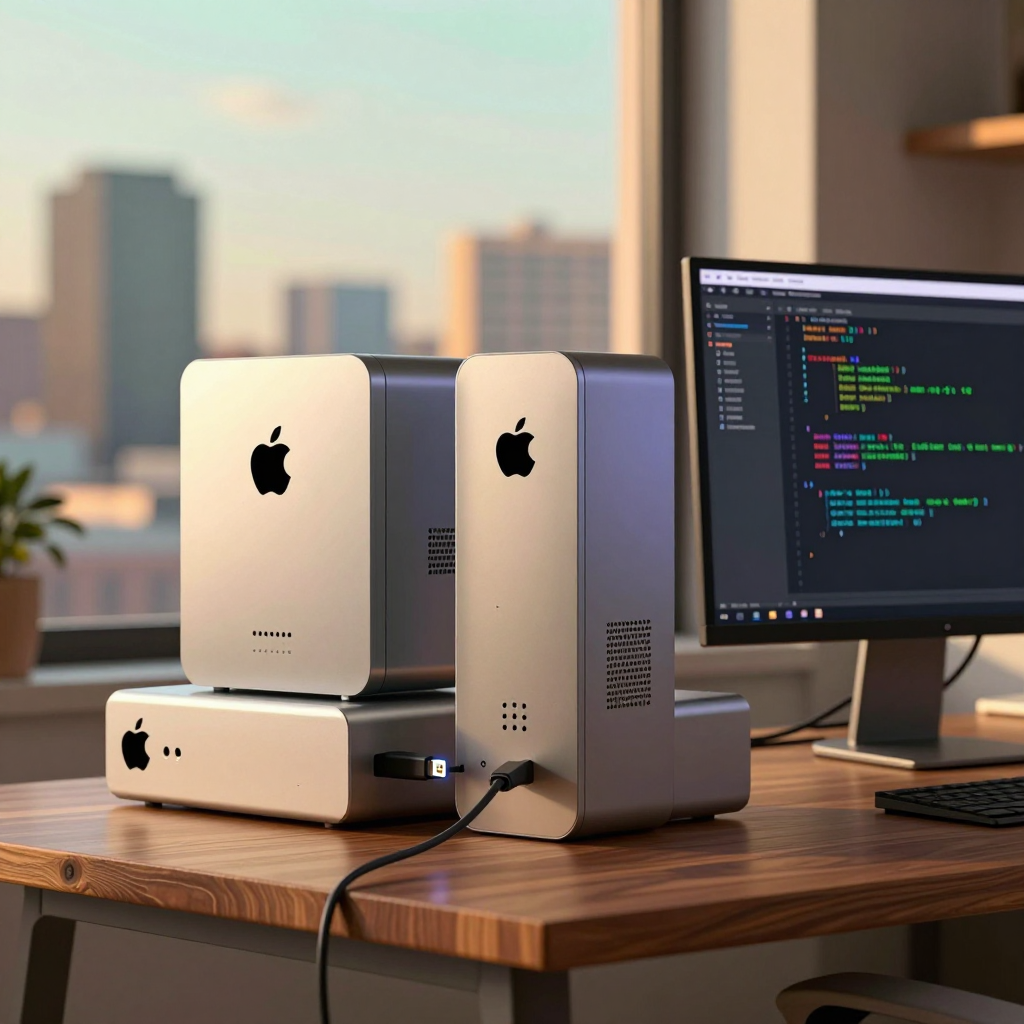
A model this large normally needs server hardware. Reports say a single Mac Studio is not enough for the full checkpoint. Two Apple M5 Ultra Mac Studios, each configurable with up to 512 GB of unified memory, can be linked to give roughly 1 TB of combined memory, and Apple's MLX framework lets the pair work as one system. Engadget, cited by TechCrunch, says running the model locally requires at least 1 TB of RAM. Meta says it runs best on the Mac Studio with the M5 Ultra chip.
Unified memory matters here because the CPU and GPU share one large pool, so very big model weights can be loaded without the copying between separate memory banks that discrete graphics cards require. For enterprise users, Meta's developer blog also describes deployment on NVIDIA's GB300 NVL72 platform.
No official price for the required Mac Studio configuration has been published, and real-world speed will depend on quantization, context length and software.
Demonstrations
Meta paired the model with Muse Code, its AI coding terminal. In one test, the model made fixes to a Mastodon client, including bug fixes, new features and a full build. Meta also used it with the video editor DaVinci Resolve, where it reviewed and cropped footage.
Availability and License
The weights can be downloaded from Hugging Face, and the model is available through cloud platforms and API providers. Reported channels include Amazon SageMaker, Google Cloud, Microsoft Foundry, OpenRouter and Together AI. It is released under the Muse Model License, which is described as allowing limited commercial use. Specific thresholds were not detailed in the coverage reviewed, so developers should read the license on the model card.
How It Compares
By total size, Muse Spark Open is larger than several well-known open-weight models. Tech Insider lists DeepSeek V3 at about 671 billion total and 37 billion active parameters, Llama 4 Maverick at about 400 billion and 17 billion, and Qwen3-235B-A22B at about 235 billion and 22 billion.
Meta says the model outperforms other popular open-weight models, but TechCrunch gave no specific benchmark scores, and independent evaluations are still pending. One headline on KuCoin cited 81.6 billion parameters, which conflicts with every other report and appears to be a typo.
Why It Matters
Open-weight models can be more cost-efficient and offer more transparency and flexibility than closed ones, since developers can run, inspect and adapt them on their own hardware. Running locally also keeps data on the user's own machine. CNBC reported that Apple and Meta worked together to make the model run on Mac hardware, although Apple is not credited as a co-developer of the model.
Meta released a separate model, Muse Wonder, on October 12, 2026. Earlier, on August 10, 2026, it released the smaller Muse Glimmer, a 30-billion-parameter open-weight model under the Apache 2.0 license that runs on a Mac or PC with a single consumer graphics card.
This article was compiled by the AIBARS editorial team with AI assistance. AI can make mistakes, so please check the original source for anything important. Spotted an error? Email [email protected].