OpenAI Says NATO Cyber Teams Use Up to 300 Billion Tokens a Month
News Summary
OpenAI said on November 17, 2026 (UTC) that it is working with NATO’s Communications and Information Agency to provide the alliance’s core institutions with access to advanced cybersecurity models through its Daybreak initiative. The company said NATO usage has reached as much as 300 billion raw input and output tokens per month, a figure that signals substantial operational activity while leaving details such as the number of users and specific workflows undisclosed.
What OpenAI announced
The collaboration is intended to support authorized cyber defense work, including reviewing software, investigating suspicious activity, validating vulnerabilities, and developing and testing fixes. OpenAI described the effort as a way to help protect allied networks and build cyber expertise among multinational teams responsible for round-the-clock defense.
The company’s announcement did not identify the specific models, technical architecture, deployment environment, or the precise start date for NATO’s access. It also did not publish a breakdown of the reported token volume. Those omissions mean the usage figure should be read as a measure of model activity, not as a direct measure of vulnerabilities found or systems secured.
Training puts people alongside AI agents
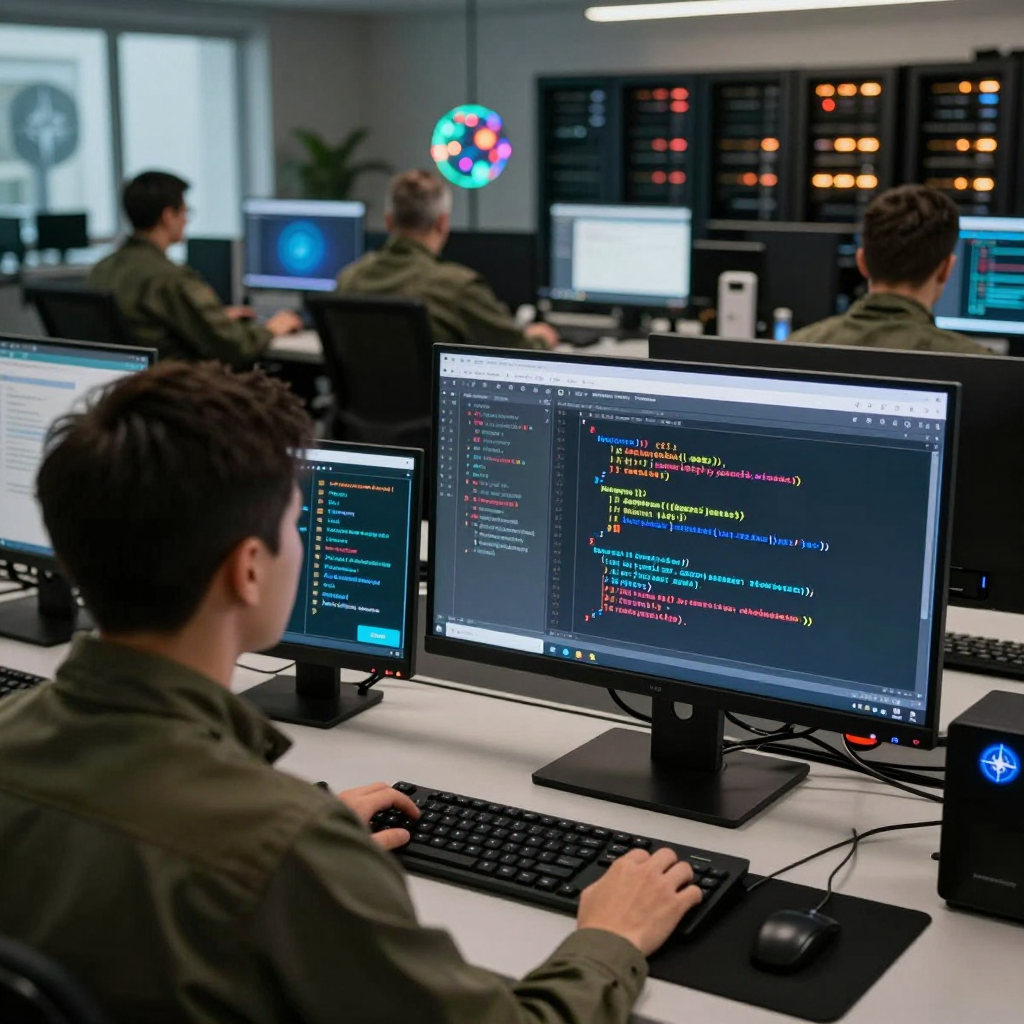
OpenAI also said it supported the 2026 Crossed Swords exercise, organized by the NATO Cooperative Cyber Defence Centre of Excellence. A new training stream let participants build, deploy, and evaluate AI agents for cyber operations in a technical environment using Daybreak. The exercise placed people alongside AI agents and emphasized human oversight.
That educational component matters because cyber defense requires more than model access. Security professionals need practice assessing machine-generated findings, checking whether a suspected weakness is real, and deciding which repair is safe to deploy. Exercises can help teams develop those skills in a controlled setting before applying them to operational systems.
Why the scale figure needs context
The reported ceiling of 300 billion tokens a month is striking, but token counts are not equivalent to completed tasks. A model may consume many tokens while exploring a question, and high usage alone does not show whether its output was accurate or useful. OpenAI and NATO did not provide public performance measures such as time saved, confirmed vulnerabilities, remediation rates, or independent evaluations alongside the number.
NATO Communications and Information Agency General Manager Dylan Browne described AI cyber defense models as tools that can speed vulnerability discovery and threat detection. He also said the alliance would seek a deeper understanding of consumption, usage patterns, and underlying economics as adoption grows, including to support cost optimization and procurement decisions. That signals an ongoing evaluation process as well as an operational collaboration.
A wider program for defenders
OpenAI positioned the NATO work within a broader effort to provide cyber models to selected public-sector defenders. The company said it has also provided access to European Union cyber agency ENISA and national cyber agencies in France, Germany, and Poland. It cited examples in which European teams used AI-assisted analysis to identify software issues and then worked with maintainers or vendors on fixes.
Across these efforts, the central technical question is how to combine faster analysis with expert review. AI can help researchers inspect code, compare behaviors, and test possible explanations, but humans remain responsible for confirming findings and overseeing consequential changes. For students and practitioners, the collaboration offers a real-world example of AI acting as an assistant in a security workflow rather than as a substitute for cybersecurity expertise.
What to watch next
Useful measures of progress would include independently verified findings, the proportion of model suggestions that withstand expert review, the time needed to validate and repair weaknesses, and the safeguards used to keep testing within authorized environments. More detail on those measures would help educators, security teams, and technology buyers understand where advanced models add value and where human judgment remains essential.
For now, the announcement establishes that NATO’s core institutions have access to OpenAI cybersecurity models and reports a high level of usage. It also highlights practical training with AI agents and human oversight. Whether the collaboration improves resilience at scale will depend on evidence about outcomes, costs, and how well teams can translate model-generated analysis into verified repairs.
This article was compiled by the AIBARS editorial team with AI assistance. AI can make mistakes, so please check the original source for anything important. Spotted an error? Email [email protected].