Alibaba Debuts Qwen4-Max With 1M Context and New Safety Controls
News Summary
Alibaba introduced Qwen4-Max on November 16, 2026, presenting it as the first and most capable model in its Qwen4 family, with a 2.4-trillion-parameter mixture-of-experts design, native image and video understanding, and a one-million-token context window. The launch combines a pitch for longer, tool-using work in software, professional workflows, and scientific research with a public account of stronger safety measures. Its headline claims on benchmark performance, cost savings, and safeguards come primarily from Alibaba; independent reporting confirms the launch and the broad direction of the safety changes, while real-world performance and risk reduction remain matters for outside evaluation.
What Alibaba announced
The company said Qwen4-Max activates 71 billion parameters per token out of 2.4 trillion total, a sparse mixture-of-experts approach intended to deliver large-model capability with lower inference costs. Alibaba describes it as supporting complex coding, visual reasoning, agent workflows, workplace productivity, and scientific exploration. QwenCloud’s developer documentation identifies Qwen4-Max as the first Qwen4 model and lists image and video understanding, tool calling, web search, code interpretation, and a one-million-token context length.
Alibaba reported sixth place on Code Arena and said Qwen4-Max outperformed its predecessor, Qwen3.8-Max, on the company’s Work360 benchmark, which covers 721 specialized fields. Under high-effort reasoning settings, the company said the new model used 35% fewer tokens and reduced average task costs by about 60%. These are company-reported figures; results depend on benchmark design, task mix, model settings, and pricing assumptions. They should not be read as a general guarantee that every user’s workload will cost 60% less.
Safety measures and their limits
Alibaba says software-engineering training combined security checks with functionality tests, with the goal of reducing flaws such as code injection, memory-safety problems, and broken access control. For cybersecurity-related training, it says it retained defensive material for identifying and fixing vulnerabilities while filtering content intended to improve offensive attack capability. It also cited dedicated safety datasets and post-training work to strengthen protections against chemical, biological, radiological, and nuclear misuse.
Reuters’ launch coverage independently reported the same broad distinction between retaining defensive cybersecurity knowledge and filtering offensive material, along with the additional safeguards for hazardous domains. That corroborates what Alibaba says it built into training and post-training; it does not by itself establish how reliably the controls perform under adversarial use. The public disclosures described here do not amount to a complete external audit, and the available launch materials do not provide a detailed independent evaluation protocol or quantified rate of blocked harmful requests.
Long-running agents and research examples
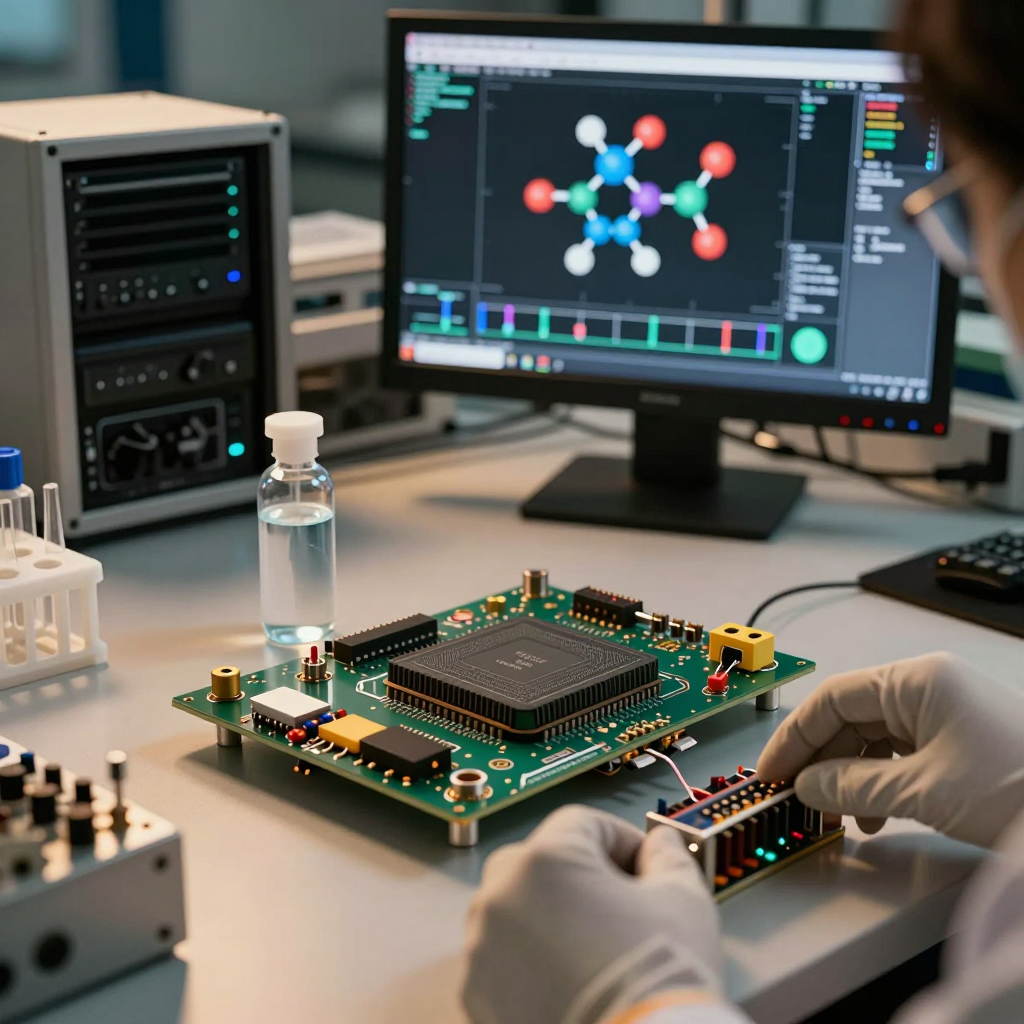
A central part of Alibaba’s pitch is that Qwen4-Max can plan and use tools over extended tasks, connecting model-generated ideas with simulations, external tools, and experimental feedback. The company described a 48-hour workflow for chip-cooling research that moved through molecular design, synthesis and testing, and active learning, and said it produced an experimentally validated coolant molecule. In an Alzheimer’s research experiment, Alibaba said the model made 454 tool calls and 3,239 metric evaluations while designing and optimizing 24 candidate molecules.
These examples illustrate how AI agents could assist researchers with iterative work, but they are company demonstrations rather than evidence that the model independently established a scientific result. The coolant claim includes experimental validation in Alibaba’s account; the drug-related candidates were described as computationally evaluated and would need further laboratory validation. Human expertise, experimental controls, and independent replication remain essential to interpreting such results.
Access, pricing, and what comes next
At launch, Alibaba said Qwen4-Max was available through QwenCloud’s Token Plan and API, as well as QwenWork and QwenStudio. Its announcement listed a price of $0.075 per million input tokens for an implicit-cache hit. That is a specific cached-input rate, not a complete estimate of total use: uncached input, generated output, reasoning settings, and tool calls can change the bill. QwenCloud documentation confirms the model’s API access and feature set, and lists deployments across several regions, including Singapore, Frankfurt, Hong Kong, Tokyo, and Virginia.
Alibaba said smaller Qwen4 models with open weights would follow, a distinction that matters for developers who want to inspect or adapt model weights and run systems in their own environments. Qwen4-Max itself is presented through hosted services and an API. Whether the broader family delivers both useful openness and dependable safety will become clearer as technical documentation, independent tests, and hands-on use accumulate.
Why the launch matters
Qwen4-Max highlights a practical challenge in current AI engineering: making systems capable of sustained, multimodal work while controlling the costs and risks that grow with tool use and access to specialized knowledge. Sparse activation and caching can improve serving efficiency, while longer context and agent workflows can help with research and software tasks. Those same capabilities increase the importance of monitoring, permission boundaries, and careful human review.
For educators and students, the model’s science examples are most useful as prompts to examine the research process: which steps were automated, what was measured, which claims came from simulations, and what was physically tested. The launch’s concrete specifications and safety disclosures provide material for that discussion, but the strongest conclusions about accuracy, cost, and misuse resistance will require transparent benchmarks and independent evaluation over time.
This article was compiled by the AIBARS editorial team with AI assistance. AI can make mistakes, so please check the original source for anything important. Spotted an error? Email [email protected].