Tenstorrent Raises $1.5 Billion at $6.2 Billion Valuation, Turning Down Intel and Qualcomm
News Summary
Tenstorrent, the AI chip company led by veteran processor designer Jim Keller, announced on Monday, October 19, 2026, that it has raised $1.5 billion in a Series E round at a $6.2 billion post-money valuation. The figure is more than double the $2.6 billion valuation the company reached in its 2024 round, as reported by Bloomberg. The money is meant to scale production of its Galaxy servers, which are built to run open-weight AI models, and to deepen work on the open RISC-V chip architecture.
The Funding Round
The round was co-led by Trace Capital, a new firm started by Quiet Capital co-founder Ben Mahdavi, and Innovation X. Coverage of the participant list varies slightly between outlets. Names reported across TechCrunch, SiliconANGLE, The Next Web and Dealroom include Fidelity, T. Rowe Price, Morgan Stanley, ARK Invest, Sandisk, Cadence Ventures, Eclipse, Protagonist, Tether Investments, Agostinelli Group, Maverick Silicon, Virtu Financial and XTX Markets.
Tenstorrent was founded roughly ten years ago. Reporting differs on its home base: some outlets describe it as Toronto-founded, while others list Santa Clara, California. The company has offices in Santa Clara, Austin, Toronto, Belgrade, Tokyo and Bangalore, and Bloomberg put its headcount at about 1,150 employees.
Why the Company Stayed Independent
Bloomberg reported in May 2026 that Tenstorrent had held acquisition talks with Intel and Qualcomm. The valuation attached to those talks is reported inconsistently: TechCrunch cites figures of up to $5 billion, while Dealroom's summary mentions one deal worth up to $10 billion. These numbers could not be reconciled from public sources, so they should be treated as unconfirmed.
According to The Next Web, Keller said a May demonstration of Galaxy servers running high-performance DeepSeek models was a turning point. After it, the company chose to raise capital rather than sell. Keller also said Tenstorrent can compete on price and serve orders that are too small for larger rivals.
The Hardware Lineup
SiliconANGLE describes a company that started as a chip designer and now sells complete AI compute platforms, including software. The main products are:
- Galaxy servers: enterprise-class systems that can be linked into superclusters for training and running large models. SiliconANGLE calls them the best-selling product.
- TT-QuietBox: a liquid-cooled desktop AI workstation for local development and testing.
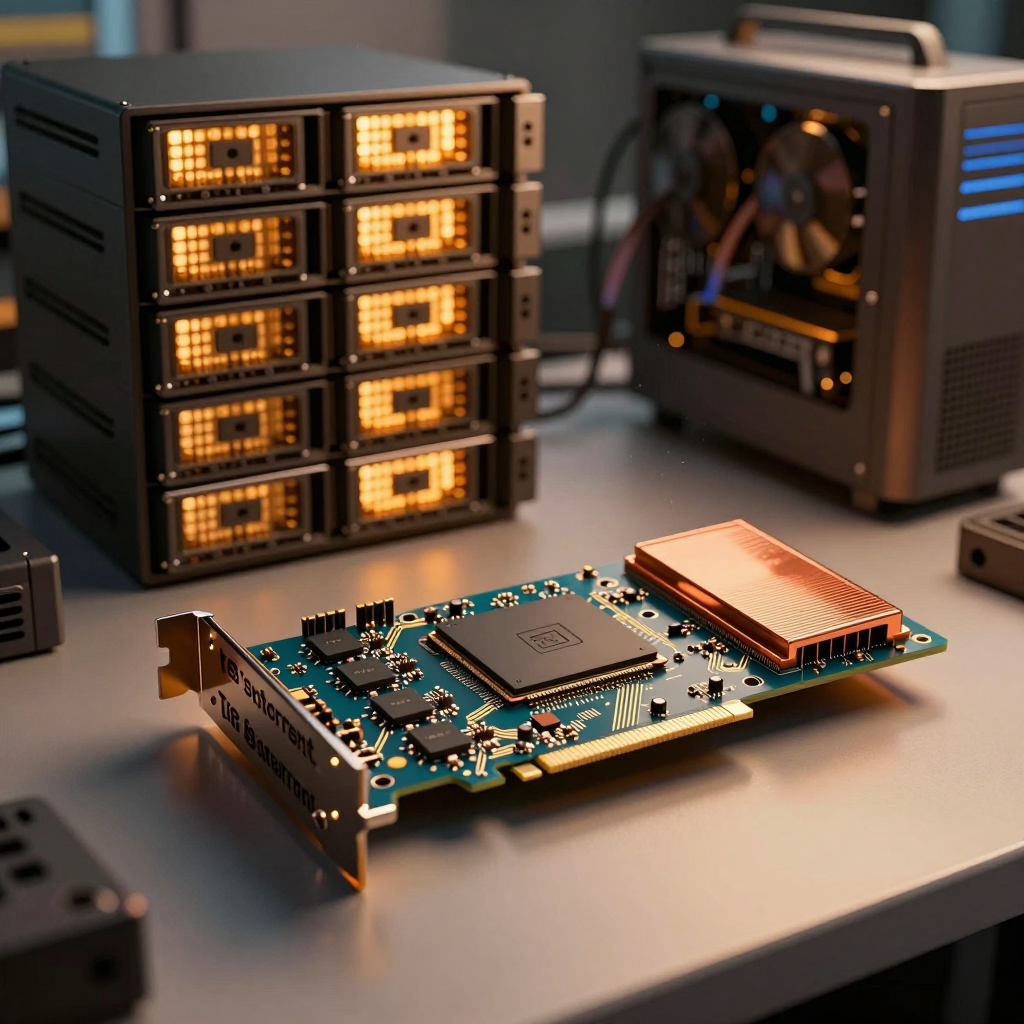
- Blackhole cards: PCIe boards with many RISC-V cores and GDDR6 memory, which can be networked to pool memory and compute.
- Processors: Tensix Neo accelerators and Ascalon CPUs, both based on the open RISC-V instruction set.
Keller summed up the approach: "We built one architecture and we sell it at every size." He added that "the future of compute is open, scalable and owned by the people building on it."
Open Software Stack
Tenstorrent publishes its software as open source. TT-Forge is a compiler that connects frameworks such as PyTorch to its RISC-V chips. TT-Metalium is an SDK for hardware optimization and custom kernel development. TT-LLK is a library for low-level kernel work. The company also licenses AI and CPU designs to firms building their own chips, with Samsung and LG named as licensees.
Customers and Use of Funds
Named users include Virtu Financial, which runs on-premises AI trading agents on Galaxy servers, and Equinix, a data center provider that offers Galaxy servers to enterprises. TechCrunch notes that no customers were named in its own report.
The new capital will go toward ramping Galaxy production for global deployment across language-model and video-generation workloads, expanding research on the RISC-V ecosystem, and growing the workforce worldwide.
Competitive Context
Nvidia, AMD and Broadcom remain the dominant AI chip suppliers. Analyst Holger Mueller of Constellation Research said that "Nvidia is not the only option anymore." TechCrunch also reported earlier in October 2026 that another chip maker, Etched, was fielding investment offers at valuations of $40 billion or more, a sign of how much investor appetite exists for inference-focused hardware.
What to Watch
Open-weight models are increasingly run on self-managed infrastructure, and an architecture built on open standards gives buyers an alternative to a single-vendor stack. The key questions now are how quickly Tenstorrent can ramp manufacturing, how many customers beyond the early names it can win, and whether its open software tools attract enough developers to compete at scale. All figures above come from press reports and company announcements; independent benchmarks were not available.
This article was compiled by the AIBARS editorial team with AI assistance. AI can make mistakes, so please check the original source for anything important. Spotted an error? Email [email protected].