Meta Releases 816B-Parameter Muse Spark Open With 1M Context, Running on Two Mac Studios
News Summary
Meta has published the weights of Muse Spark Open, an 816-billion-parameter multimodal model that it describes as the most capable open-weight model from a US developer to date. The announcement is dated October 15, 2026 on Meta's research site; Meta does not state a time of day, so no timezone can be attached to the release moment. The model uses a mixture-of-experts design with 42 billion parameters active per token, accepts up to one million tokens of context, and is aimed at coding and long-running agent tasks.
What Meta Released
Muse Spark Open has 816 billion total parameters, but only about 42 billion are active when it processes each token. This is the core idea of a mixture-of-experts (MoE) model: many specialist sub-networks exist, and a router picks a small subset for each step. The result is a very large knowledge capacity at a much lower per-token compute cost than a dense model of the same size. The model is natively multimodal, meaning it was trained to handle text and images together rather than having vision bolted on later, and it supports a 1M-token context window, enough to hold a large codebase or hours of transcribed material in one session.
Weights are listed on Hugging Face under the repository name meta-models/Muse-Spark-Open-816B-A42B, in BF16 precision, with a separate NVFP4 (4-bit floating point) build for lower memory use. Meta also lists downloads through Amazon SageMaker AI, Google Cloud Model Garden and Microsoft Foundry Models.
Focus on Coding and Agents
Meta positions the model for software engineering, multi-step reasoning and long-horizon agentic work, where a model plans, calls tools and keeps going across many steps. Two demonstrations were shown using Muse Code, Meta's coding tool powered by the model. In the first, it made changes to the open-source Mastodon client Ice Cubes for iOS. In the second, it handled end-to-end video editing in DaVinci Resolve, reviewing footage frame by frame and cropping the strongest moments into vertical clips.
Running a Frontier-Scale Model on a Desk
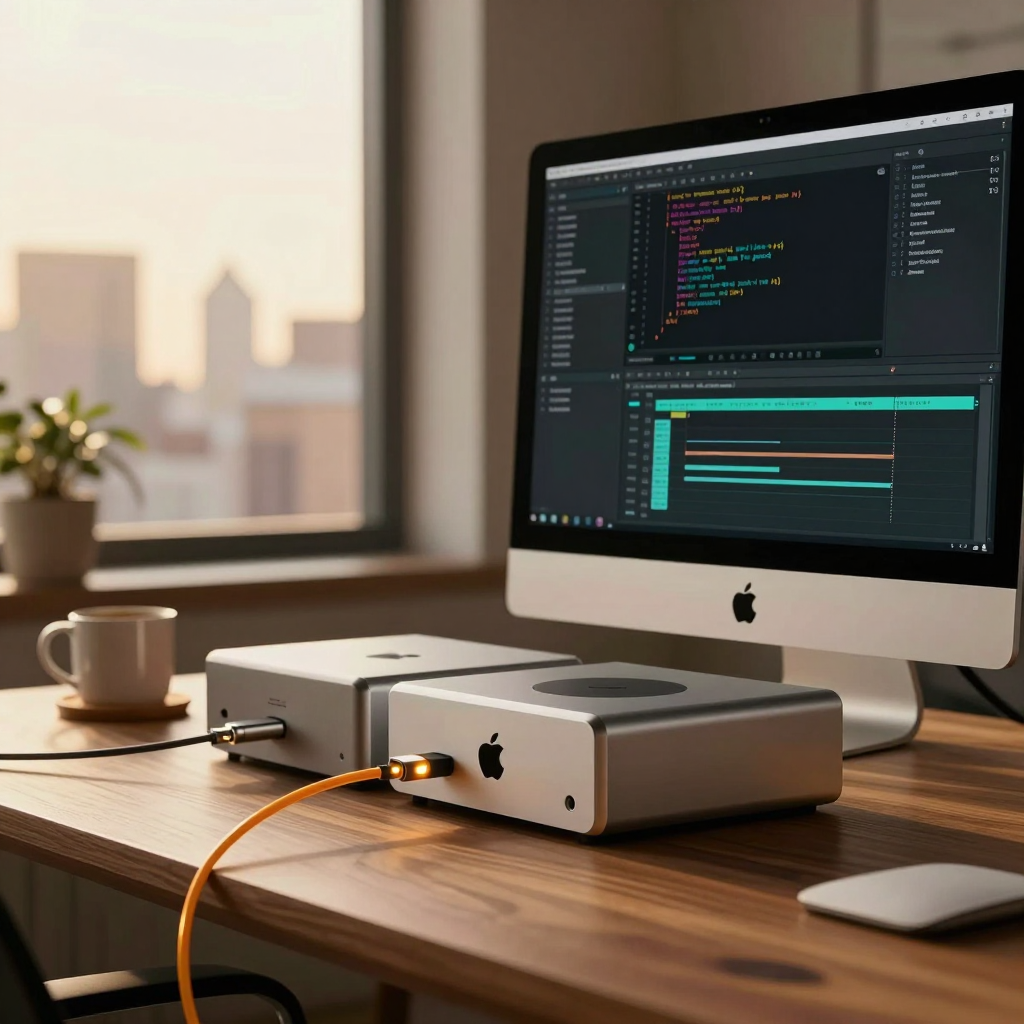
The most eye-catching claim is local deployment. Meta says the model runs on two Apple M5 Ultra Mac Studio computers using Apple's MLX framework. Each machine can give its integrated GPU up to 512 GB of unified memory and offers 1.2 TB/s of memory bandwidth, so the pair provides roughly one terabyte of memory shared between CPU and GPU. Unified memory matters for large models because the weights do not have to be copied between separate system and graphics memory. Meta frames this as part of a belief that "the future is for everyone," including running advanced models at home.
For readers new to the topic, quantization explains how this is possible. Storing each weight in fewer bits, as the NVFP4 build does, shrinks the memory footprint, usually at some cost in accuracy that varies by task.
Access, Tooling and Speed
Hosted API access is listed through Baseten, Fireworks AI, Groq, Modal, Nebius, OpenRouter and Together AI. Supported inference engines include SGLang, vLLM, TensorRT-LLM, Hugging Face Transformers, Apple MLX, llama.cpp and Unsloth, with optimizations for AMD, Apple, Intel and NVIDIA hardware. Fine-tuning is supported through PyTorch and TorchTitan.
On performance engineering, Meta says custom auto-tunable Helion GPU kernels in SGLang give kernel-level speedups of 1.03x to 3.95x on NVIDIA and AMD GPUs, and a 3% end-to-end speedup on AMD MI350 hardware. A kernel is a small GPU program that performs one core operation, so speedups there only partly carry through to whole-model throughput, which is why the end-to-end figure is smaller.
License and Safety
The model ships under the Muse Model License, which Meta describes as having limited commercial terms that let many developers use it for free. Independent coverage notes it allows using, modifying, fine-tuning, distilling and redistributing the model but adds conditions that a classic open-source license would not, so "open-weight" is the more accurate label than "open source." Teams should read the license text before building products on it.
Meta says the model received additional safety post-training and was evaluated under its Meta Superintelligence Scaling Framework, stating it met the framework's release thresholds. Meta's own summary is that "the results demonstrate strong safeguards across risk categories measured." Detailed results are in the model card, and a fuller evaluation report is described as coming soon.
Context: Where This Fits in Meta's Model Line
Meta introduced Muse Spark in April 2026 as a proprietary model while saying it planned to open future versions. A 30-billion-parameter open model, Muse Glimmer, followed under Apache 2.0 in August 2026 according to secondary coverage, and Meta's leadership later said weights for a newer Muse Spark version would follow. Muse Spark Open is the large-scale step in that sequence. Secondary outlets also report newer hosted Muse Spark versions, so the open model should not be assumed to match Meta's latest proprietary release.
What to Treat With Care
Meta's research page has a Key Benchmarks section and links to an evaluation methodology report, but the benchmark figures could not be extracted for this report, and trade coverage notes that independent evaluations have not yet confirmed Meta's capability claims. The "most capable US open-weight model" description is Meta's own framing. Practical questions such as real-world speed on a two-Mac setup, quality of the quantized build and behavior on long contexts will be answered as the community tests the weights.
Why It Matters for Learners
For students and developers, the release is a chance to study a frontier-scale mixture-of-experts model directly: inspect its structure, run it with open tooling, fine-tune smaller adaptations and compare quantization trade-offs. It also shows how hardware with large unified memory is changing what can run outside a data center.
Sources
Meta Research (research.meta.ai/blog/muse-spark-open); the Hugging Face model card and collection; MarkTechPost, Unite.AI, Analytics India Magazine, iGeeksBlog and DEV Community coverage dated around October 15, 2026; The Register and Constellation Research for earlier Muse model context.
This article was compiled by the AIBARS editorial team with AI assistance. AI can make mistakes, so please check the original source for anything important. Spotted an error? Email [email protected].