OpenAI Bought Tens of Thousands of Mac Minis and Mac Studios for AI Training
News Summary
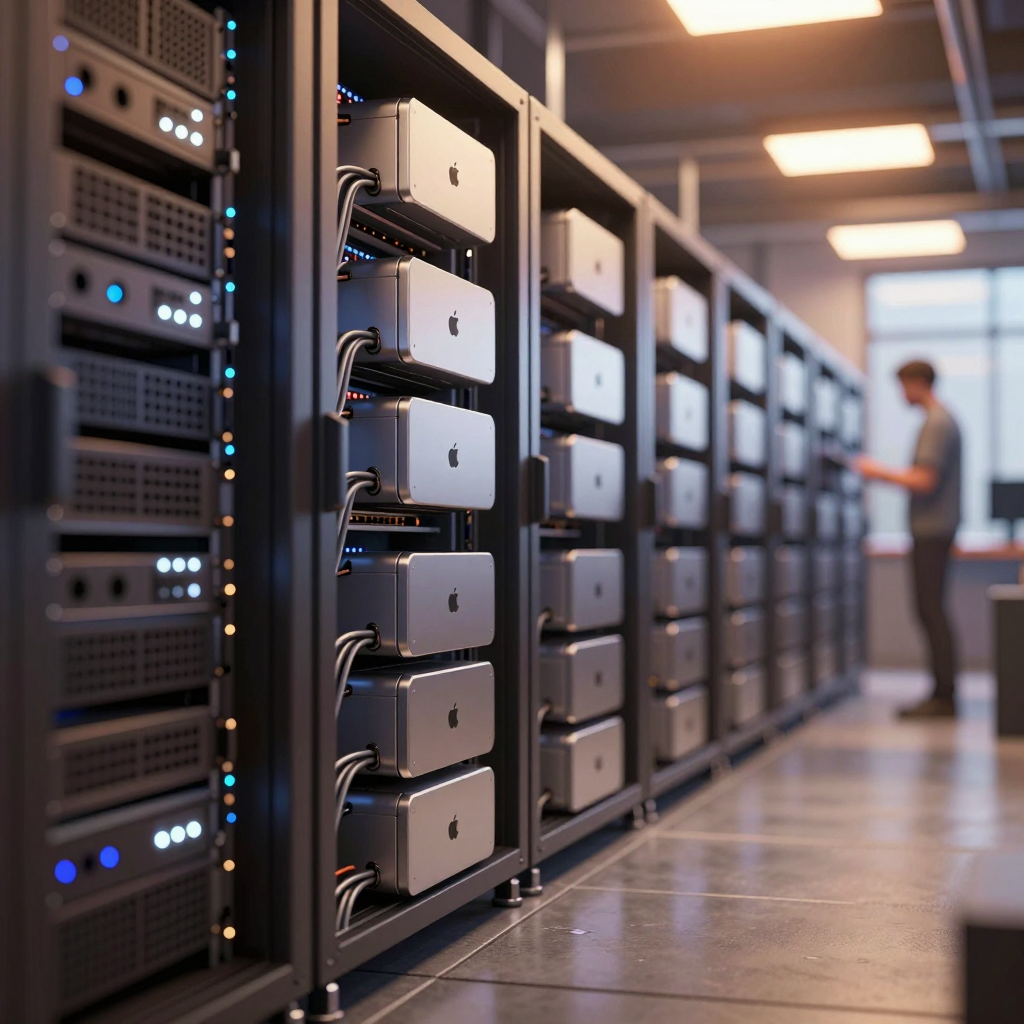
Over the past several months, OpenAI has quietly purchased tens of thousands of Apple Mac mini and Mac Studio computers, according to reporting from The Information that has since been corroborated by multiple technology outlets. The machines are reportedly being used not for office work but as compute nodes dedicated to reinforcement learning and the training of "computer-use" AI agents — systems designed to navigate software interfaces, click buttons, fill out forms, and complete multi-step digital tasks the way a human would. The purchase, confirmed as of 2:00 PM Eastern Time on August 31, 2026, marks one of the most unusual hardware procurement stories in the AI industry this year, and it has already begun reshaping supply and pricing for Apple's small-form-factor desktops.
Why OpenAI Is Buying Macs Instead of More GPUs
OpenAI's headline-grabbing compute strategy has long centered on massive GPU clusters for pretraining large language models. The Mac purchases represent a different, complementary workload. Reinforcement learning for computer-use agents requires an AI system to operate inside a real desktop operating system — observing a screen, taking an action, and receiving feedback — repeated millions of times across many parallel environments. That workload is described by industry analysts as memory-bound and comparatively light on raw parallel throughput, which is a very different profile from the dense matrix multiplication that defines transformer pretraining on Nvidia GPUs.
Apple's M-series chips use a unified memory architecture, in which the CPU, GPU, and Neural Engine all draw from a single shared memory pool rather than moving data between separate memory banks. For workloads that involve running full desktop environments and rapidly cycling through agent actions, this design reduces data-movement overhead and lets each machine host a complete, self-contained "workstation" for an AI agent to practice on. Industry observers note the Mac Studio's M5 Ultra configuration, which supports up to 512GB of unified memory and roughly 1.2TB/s of memory bandwidth, is particularly well suited to efficient inference and fine-tuning of mid-sized models, even though large-scale pretraining remains squarely in Nvidia's domain.
Scale and Sourcing of the Purchase
Neither OpenAI nor Apple has issued an official statement confirming an exact unit count or dollar figure. The Information's original reporting, since echoed by outlets including Business Today, Cult of Mac, and WCCFTech, describes purchases in the "tens of thousands" of units across both the compact Mac mini and the more powerful Mac Studio line. The devices are reportedly acquired as headless, screen-free server nodes rather than desktop computers, and racked in data center-style deployments rather than used on individual desks.
OpenAI is not alone in this approach. Anthropic has taken a related but distinct path, renting Mac mini capacity through Amazon Web Services rather than purchasing hardware outright. That approach trades a markup paid to AWS for flexibility to scale usage up or down without capital expenditure, while depending on AWS's own available Mac mini inventory. Together, the two companies' strategies suggest Apple silicon is becoming a recognized, if still niche, tool in the broader AI infrastructure stack, alongside — not in place of — conventional GPU clusters.
Impact on Apple's Supply Chain
The scale of AI-industry buying has begun to visibly strain Apple's consumer supply chain. Reports indicate Apple has quietly removed several high-end RAM configurations from the Mac Studio and Mac mini lineups, and delivery estimates for some configurations have stretched to nine to twelve weeks. Memory manufacturers have reportedly been prioritizing supply contracts for AI data centers, which are more profitable per unit than consumer device memory, leaving less capacity available for Mac production even as consumer demand remains strong. Apple's Mac segment posted revenue growth of nearly 29 percent year-over-year in its most recent quarter, a figure that reporting suggests has been boosted in part by this unconventional wave of enterprise AI demand.
Some reports also describe the memory crunch as a contributing factor in Apple accelerating the release of refreshed Mac mini and Mac Studio models earlier than originally planned, in an effort to keep pace with orders from AI labs alongside its traditional consumer and creative-professional customer base.
What It Signals About AI Infrastructure Strategy
The episode illustrates a broader trend: as AI labs diversify beyond pure pretraining into reinforcement learning, agent training, and inference, they are increasingly matching specialized hardware to specialized workloads rather than defaulting to the largest available GPU cluster for every task. For computer-use agents in particular, a large fleet of individually capable, memory-rich desktop-class machines can be a more practical and cost-effective environment for large-scale trial-and-error training than equivalent GPU capacity would be. Analysts caution this does not signal a shift away from Nvidia hardware for core model training, where GPU memory bandwidth and interconnect speed remain decisive advantages, but it does mark a notable expansion in how leading AI labs think about compute diversity as agentic AI systems move toward broader deployment.