A Government Stake in Nvidia Would Put AI Infrastructure in Focus
News Summary
In an interview published on November 24, 2026, President Donald Trump told the New York Post that he had considered whether the U.S. government might hold an equity stake in Nvidia, the chip designer whose processors are central to many artificial intelligence systems. He said he had not raised the idea with the company, while describing Nvidia’s success as important to U.S. AI leadership. The comment was exploratory: the interview did not announce a proposal, investment terms, or a decision.
What the interview reported
The New York Post conducted the interview at the Oval Office before Trump departed for Florida for the Thanksgiving holiday. The newspaper reported that he said the idea of government ownership in Nvidia had crossed his mind and that it might not be too late to consider it. He compared the possibility with the government’s previously reported investment in Intel, but offered no specific mechanism for Nvidia.
The distinction between considering an idea and putting it into effect matters. The interview described no negotiations, valuation, share percentage, timetable, or public financing plan. It therefore leaves open basic questions that would have to be answered before any such investment could be evaluated.
Why Nvidia matters to AI
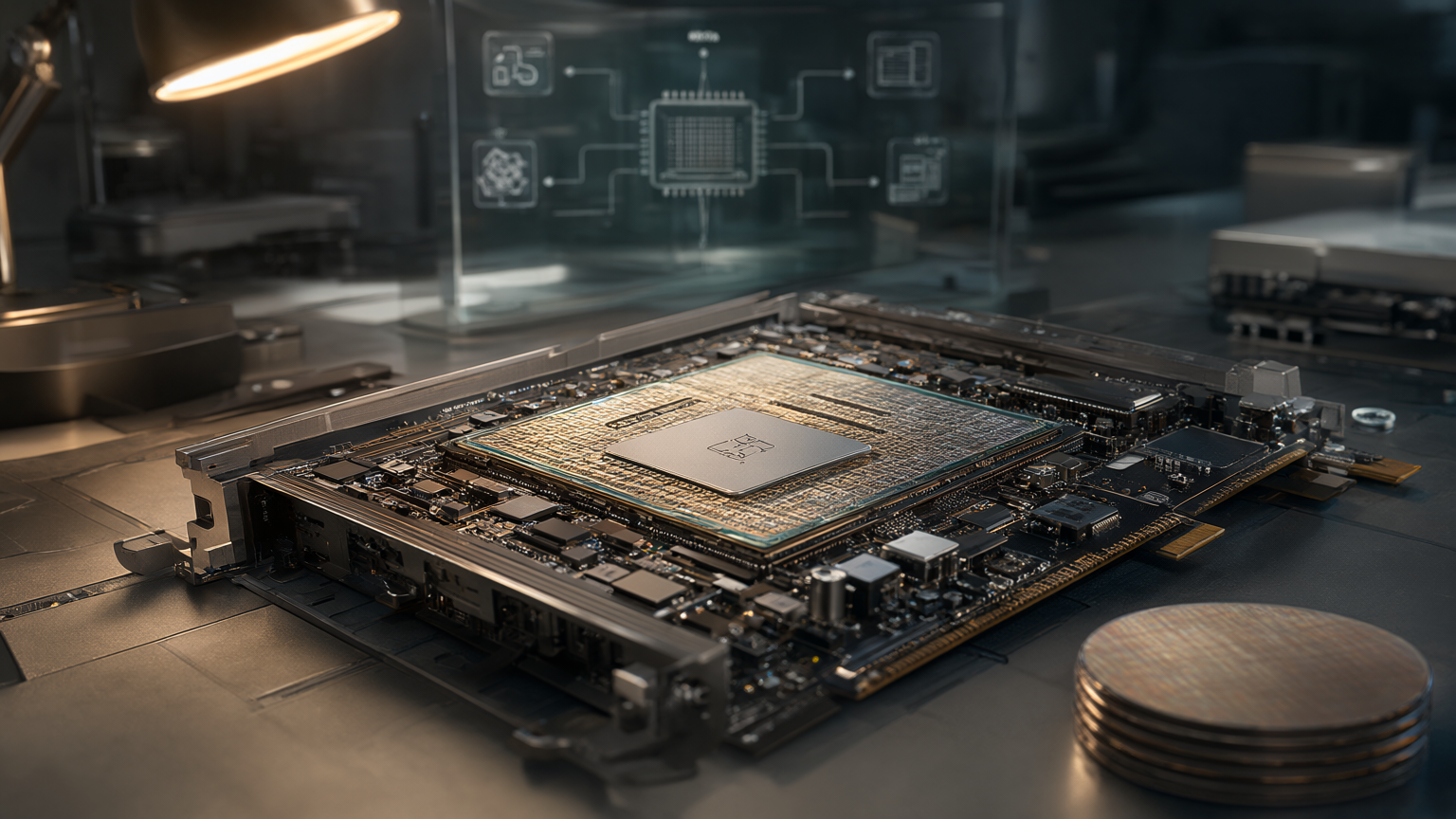
Nvidia designs graphics processing units (GPUs) and related systems used to train and run many modern AI models. Training uses large amounts of computation to adjust a model’s parameters; inference uses the trained model to generate responses, classify information, or create other outputs. GPUs can perform many calculations in parallel, making them useful for these workloads.
The company’s role also reflects a broader technology stack. Chips depend on advanced manufacturing, memory, networking, software tools, data centers, and reliable power. AI capability is therefore shaped not just by one processor maker, but by how these components work together and how widely researchers and developers can access them.
The investment question
A government equity stake would differ from research grants, procurement contracts, loans, or tax incentives. Equity generally gives an investor an ownership interest whose value can rise or fall with the company. The interview did not specify whether any hypothetical stake would involve newly issued shares, a purchase of existing shares, or another arrangement.
Those choices would affect how an investment is financed and what it means for the company and its shareholders. Any assessment would also need to consider the public purpose, governance arrangements, financial risk, and how an investment might relate to competition and access to computing resources. The interview supplied no policy framework on these points.
What educators and learners can take from the story
For students of computer science, engineering, and economics, the discussion offers a practical case study in the links between AI research and industrial capacity. It invites questions such as: Which parts of the AI supply chain are hardest to expand? How do public research funding and private investment contribute differently? What measures can help universities, small companies, and independent researchers obtain computing time?
A useful classroom exercise is to compare several policy tools—publicly funded research, competitive procurement, loans, and equity investment—against shared criteria: who bears the risk, who receives the benefit, how decisions are governed, and whether the approach broadens access to technology. The reported interview provides a starting point for that analysis, while leaving the proposal itself undefined.
What is known and what remains open
As of November 25, 2026, the reported statement indicates that Trump had considered a government stake in Nvidia, but it does not establish that the government had proposed or pursued one. No percentage, price, funding source, or implementation details were reported in the interview. Further developments would be needed to determine whether the idea advances beyond a public comment.
This article was compiled by the AIBARS editorial team with AI assistance. AI can make mistakes, so please check the original source for anything important. Spotted an error? Email [email protected].