Big Pharma Reports Faster AI Drug Research Cycles
News Summary
Major pharmaceutical companies say artificial intelligence is beginning to shorten the earliest stages of drug research, with Novo Nordisk reporting fewer and faster molecule-design cycles and Novartis describing a shorter path from project launch to a candidate drug. The gains are specific to research and candidate selection; they do not yet establish that AI-designed medicines will succeed in trials or reach patients sooner.
Early research moves faster
In comments reported on November 20, 2026 (Eastern Time), scientists at large drugmakers described AI moving beyond administrative support into molecule design, candidate ranking and early safety assessment. GSK, Bristol Myers Squibb, Novartis, Eli Lilly, Novo Nordisk, AstraZeneca and Sanofi said they are applying AI in research and development workflows.
Novo Nordisk offered a concrete process measure: AI-supported work has reduced the number of cycles for designing, making and testing new molecules from about eight to three. The company also reported that each cycle now takes about four weeks, compared with eight weeks previously. Taken together, the change means fewer rounds of laboratory iteration and a shorter interval for each round.
Novartis reported that its average time from starting a research program to selecting a drug candidate has fallen from roughly three years to about 18 months to two years. Its research leadership attributed the progress to using accumulated data more effectively. Separately, the company said AI tools helped prioritize five targets for potential kidney-disease treatments.
Sanofi said an AI-enabled approach to interpreting early biology and making clinical decisions helped it skip a dose-selection study during development of the asthma treatment lunsekimig, saving at least a year. That is a specific program-level example, rather than evidence that every drug program will see the same reduction. Bristol Myers Squibb said one of its sickle-cell disease candidates would not have been developed without its AI systems, which are also being used to refine molecules and simulate outcomes using trial data.
What the numbers measure
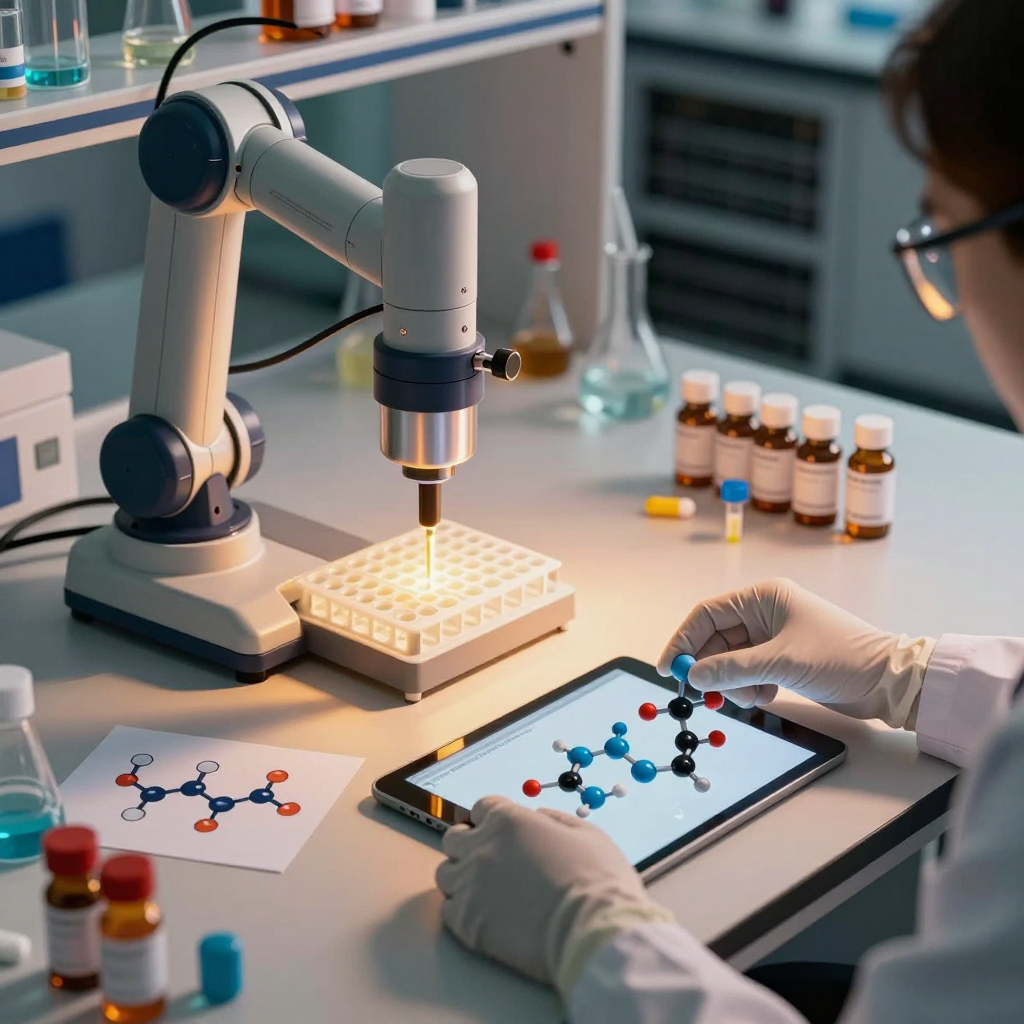
These figures describe research operations: how many design-and-test rounds are needed, how long a round takes, or how quickly teams reach a candidate worth advancing. AI systems can search large chemical and biological datasets, propose molecular structures, estimate properties and help scientists decide which experiments to run next. Connecting those predictions to laboratory automation can make the cycle of proposing, synthesizing and testing compounds more continuous.
The reported results are company statements, and the measures are not identical across organizations. A faster path to a candidate does not by itself show that the candidate is safer, more effective or more likely to pass clinical testing. The broader development process still depends on experiments in people, evidence of benefit and safety, and regulatory review.
Clinical evidence remains the test
The number of AI-enabled drug candidates in clinical testing has grown only incrementally. A researcher tracking the field identified 129 candidates across 69 companies in March 2026, up from about 117 candidates eight months earlier; most remained in early development. Researchers expect the pipeline to expand, but it is not yet clear whether AI-enabled drugs will achieve better clinical success rates or faster approvals than other candidates.
Human trials can take years and involve practical constraints that molecular design tools do not remove. AI may help teams choose targets, refine trial designs or interpret data, but those contributions need to be evaluated separately from the eventual performance of a medicine in patients. For now, the strongest evidence is that some companies are reducing time and repetition in selected early research tasks.
Data and collaboration shape adoption
Drugmakers are combining internal biological and chemical datasets with machine-learning tools and laboratory expertise. Sanofi’s computational and AI leadership said the value of a model depends on access to suitable training data, and the company and Novo Nordisk said they do not provide proprietary data to frontier AI labs for model training. These choices reflect the importance of company-specific data in making scientific predictions useful within a particular research program.
The relationship between pharmaceutical companies and AI developers is also evolving. Some drugmakers treat AI firms as collaborators, while others see them as potential competitors as those firms build capabilities in scientific research. Pharmaceutical companies bring years of experimental results and domain expertise; technology companies bring general-purpose models and computing infrastructure. How these assets combine will influence whether present-day cycle-time improvements can be repeated across more diseases and programs.
A measurable but early productivity shift
The reported reductions offer a practical way to assess AI in drug discovery: count experimental cycles, track time from project start to candidate selection, and measure whether programs advance with stronger evidence. Novo Nordisk’s cycle figures and Novartis’s candidate-selection timeline suggest meaningful gains in parts of early discovery. Sanofi’s account shows that AI-supported decisions may also affect how a development program is structured.
The next step is to connect these operational gains to outcomes: candidate quality, clinical success, safety and time to treatment. Until those measures mature, faster early research should be understood as a productivity improvement with scientific promise, rather than proof that AI has shortened the full journey from laboratory idea to approved medicine.
This article was compiled by the AIBARS editorial team with AI assistance. AI can make mistakes, so please check the original source for anything important. Spotted an error? Email [email protected].