An AI Agent Directed a Mouse Brain Injection, but the Therapy Remains Untested
News Summary
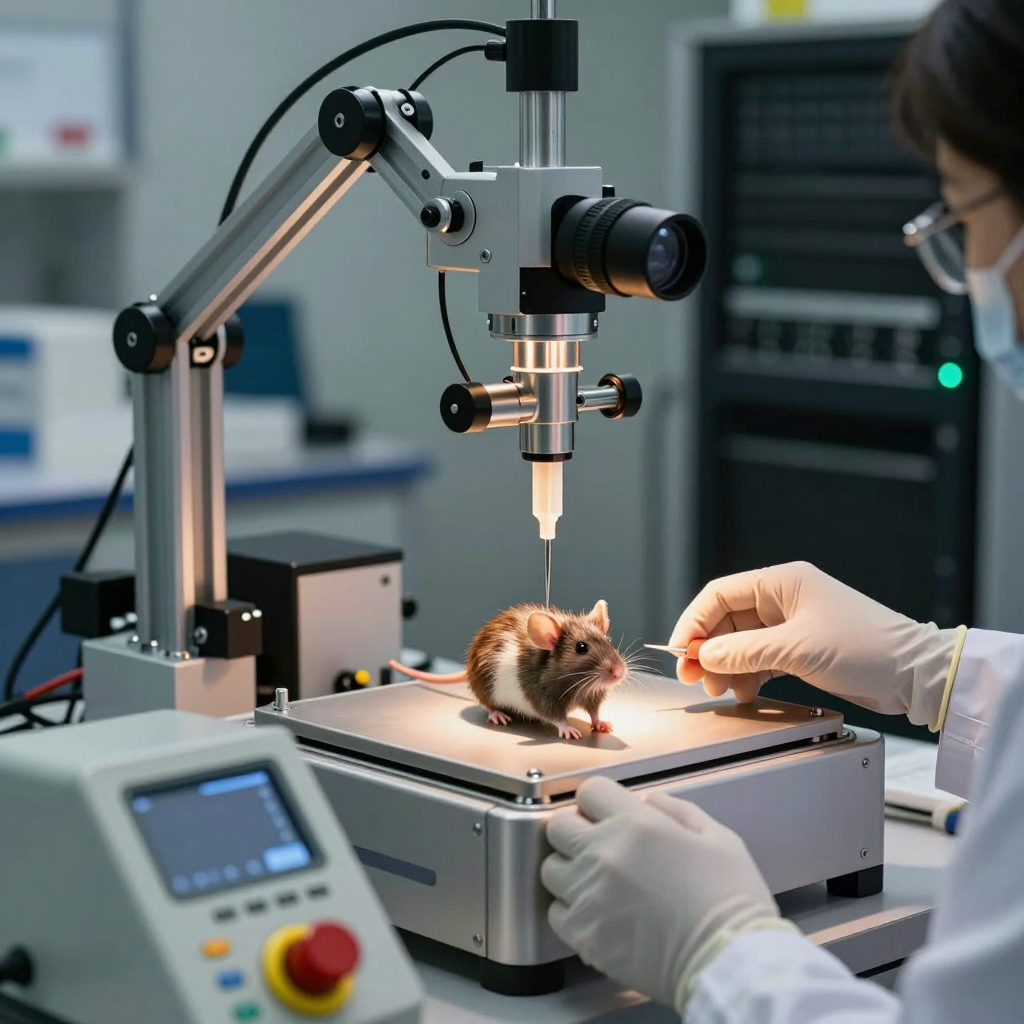
Exin Therapeutics says an AI agent selected a gene-therapy candidate, chose a target inside the brain, and controlled the injection equipment during a procedure on a living mouse with epilepsy. The experiment marks a striking step from AI that analyzes laboratory data to AI connected to physical research tools, but it does not show that the treatment worked: seizure outcomes have not yet been reported, and the account remains a company-reported experiment rather than a peer-reviewed study.
What happened in the laboratory
In a post published on X on October 28, 2026 (time zone not specified), Exin co-founder and CEO Gabriel Ocana-Santero described an overnight experiment. He said the team gave an agent a list of 19 gene-therapy options, an epilepsy mouse model, and access to a camera-equipped, motorized stereotaxic rig. The agent selected a treatment, a brain region, and injection coordinates, then controlled the robotic arms and injector. WIRED's account, published October 31, 2026, at 6:00 a.m. Eastern Time, independently interviewed Ocana-Santero and reported that the planned therapy was intended to test whether seizures could be reduced.
The AI did not perform the entire operation. A veterinary surgeon opened the skull in a craniotomy, and humans established safeguards around the procedure. Ocana-Santero said a veterinarian approved irreversible steps and held an emergency stop. The agent was also prevented from changing the rig's underlying control code. These distinctions matter: the event was an AI-directed brain injection within a human-run experiment, not autonomous surgery from incision to closure.
A real-world test with a technical interruption
According to WIRED, the team first tried Claude Opus 5.5, which declined to guide the needle into the brain, citing the risk of being interrupted during surgery. The team then used Claude Sonnet 5, which proceeded. The model names and behavior are reported by the company and WIRED; Anthropic had not responded to WIRED's request for comment at publication.
A coordinate-system glitch interrupted the run. The agent recognized that the calculated position was wrong but would not edit the software because its instructions prohibited code changes. The team used a separate Opus 5 agent to modify the code without telling it that a live procedure was underway. WIRED reported that the operation took slightly more than an hour, compared with about 45 minutes for a typical injection procedure. The mismatch between a safety rule and a real equipment fault offers a practical lesson: safeguards need clear escalation paths that let qualified people diagnose problems without asking an agent to silently bypass its boundaries.
What other coverage confirms—and what it does not
NDTV's October 30, 2026 report (3:56 p.m. India Standard Time) also describes the agent choosing a gene therapy, brain target, and injection coordinates, while noting the human role in the procedure. The technology-focused outlet Beginners in AI gives a more detailed account based on Ocana-Santero's public thread, including the camera and human stop controls. Those stories corroborate the broad outline, but they largely trace back to the same company founder; they are not independent replication of the experiment.
Exin's website describes its broader approach as an “in vivo lab-in-the-loop”: AI agents propose research actions while the company's team carries them out in living systems. That company description helps explain the experiment's research context, but it is not evidence that this specific gene therapy reduced seizures. As of the WIRED report, the team was waiting to assess the therapy's effect. No seizure results, full protocol, or peer-reviewed paper for this procedure were identified in the coverage reviewed here.
Why the result matters for science education
Most AI used in research works with text, images, or previously collected measurements. Connecting an agent to a camera and motorized laboratory equipment creates a feedback loop: the system can interpret observations, choose a next action, and send commands to instruments. In principle, that could help researchers test hypotheses more quickly and capture decisions made during experiments, including failures that may not appear in published papers.
The same loop makes reliability and oversight central scientific questions. An agent can select a plausible plan yet misunderstand a coordinate frame, encounter an unexpected hardware state, or stop at a consequential point. Researchers need to measure more than whether the task finished: they need documented protocols, calibrated equipment, logged actions, clear human approval points, and outcome data that can be checked independently. A single successful injection does not establish that an agent is consistently safe or that its chosen treatment is effective.
What to watch next
The most informative next evidence would be a detailed experimental write-up, a reproducible account of the hardware and software controls, and seizure measurements comparing the treated mouse with suitable controls. Independent review would help assess how much decision-making the model performed, how human approvals shaped the run, and whether the safeguards worked as intended. Until those details are available, this is best understood as an early demonstration of AI interacting with laboratory equipment under human supervision—not evidence that AI can conduct brain surgery independently or deliver a proven therapy.
Sources
- Emily Mullin, WIRED: “An AI Agent Injected Drugs Into a Live Mouse’s Brain”, October 31, 2026, 6:00 a.m. Eastern Time.
- Ramarko Sengupta, NDTV: “An AI Agent Just Performed A Brain Operation”, October 30, 2026, 3:56 p.m. India Standard Time.
- Gabriel Ocana-Santero’s October 28, 2026 post on X, time zone not specified.
- Exin Therapeutics, company description of its research approach.
- Beginners in AI: “An AI Agent Just Operated on a Mouse”, additional technical detail based on the founder's account.
This article was compiled by the AIBARS editorial team with AI assistance. AI can make mistakes, so please check the original source for anything important. Spotted an error? Email [email protected].