Genie 4 Brings Native Audio and Live Text Steering to Google's World Model
News Summary
Google DeepMind announced Genie 4 on Tuesday, October 27, 2026, a new world model that generates interactive, photorealistic environments in real time and, for the first time in the Genie line, produces audio natively alongside the visuals. The release is a research preview limited to trusted testers for now, with a broader rollout to Google AI Ultra subscribers planned in the coming weeks.
What Genie 4 Is
A world model is an AI system that simulates how an environment looks and behaves, so a user can move through it and change it as it runs. Genie 4 is the successor to Genie 3, which Google released as a research preview a little over a year earlier. DeepMind describes the new model as natively multimodal: it generates visuals, sound and interactive dialogue together, rather than adding audio afterward.
According to DeepMind, the model simulates how a world responds to an initial event, including how it sounds and how the people in it move, react and speak. It also improves photorealism and fluid motion, and it simulates real-world physics such as aerodynamics and collisions.
Native Audio
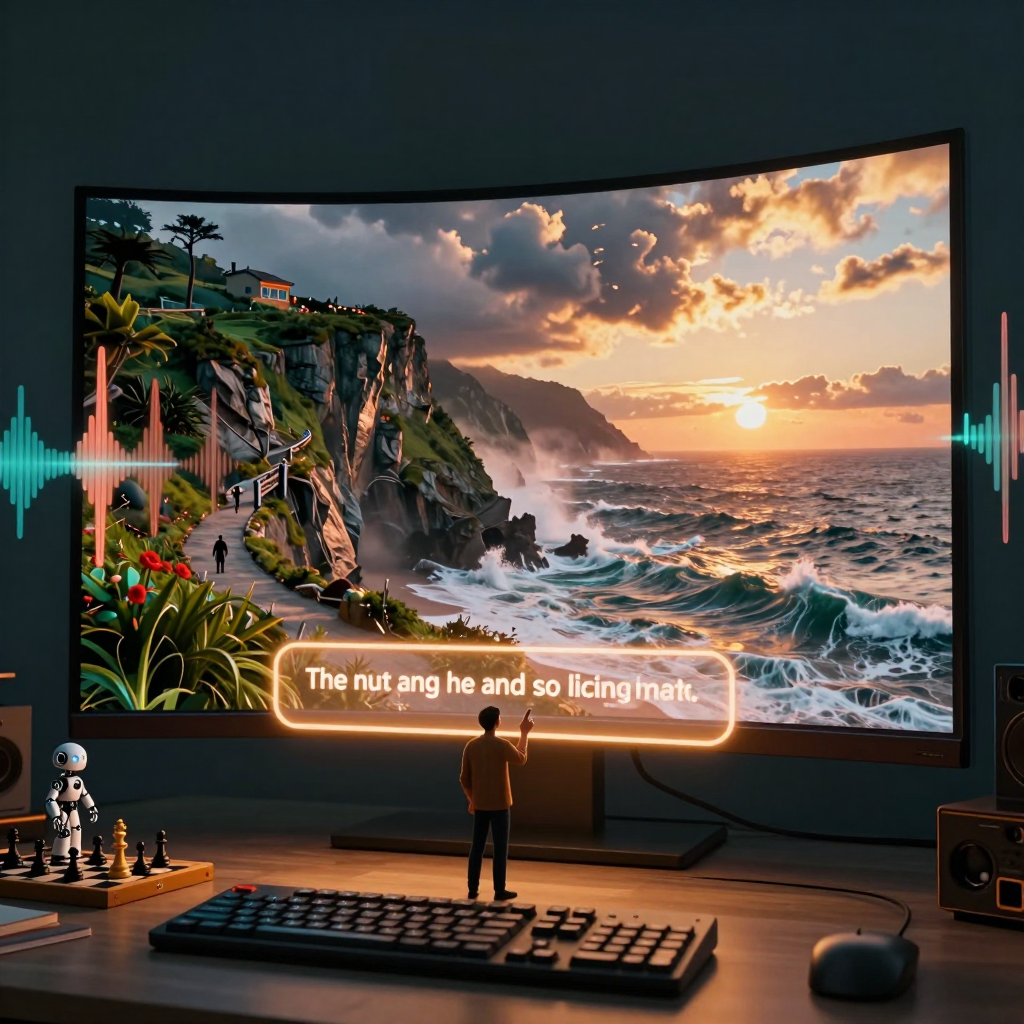
DeepMind calls Genie 4 the first real-time world model to generate audio natively. Each world gets ambient sound suited to its setting, such as wind or waves. Music is generated as well, and characters can hold real-time dialogue that adapts to what the user does and to events in the scene.
TechCrunch notes that a competitor, Runway, released a playable world model with audio generation, GWM Worlds 2, a couple of months earlier. Google's Veo video model also produces high-definition video with synchronized audio, though it generates clips rather than explorable worlds.
Real-Time Steering
Users move around and control the camera with standard keyboard controls. While a simulation is running, they can also type text prompts to change it, for example by altering the weather, shifting the camera angle, or adding a person or object. Gemini adapts each prompt to fit the surrounding scene and keeps the world progressing coherently between inputs.
Characters in the world move naturally, respond to their surroundings and can be steered in real time. TechCrunch reports that scenes now stay consistent for up to two minutes, double the limit of Genie 3.
How Gemini Works Inside the Loop
Genie 4 pairs pixel-level rendering with Gemini's structured reasoning. DeepMind says Gemini Omni anchors simulations in real-world appearance and behavior, while other Gemini models provide reasoning that maintains coherence and continuity. Gemini 3.8 Flash acts as a guiding agent: it observes the scene, breaks goals into steps, verifies each step, and adjusts its plan when the world shifts or the user intervenes.
Tejas Kulkarni, a research director at Google, told TechCrunch: "What we'll increasingly see in the future are these hybrid world models." DeepMind's own post points in the same direction, proposing hybrids that combine Gemini's reasoning with Genie's rendering.
Robotics and Agent Training
DeepMind positions Genie 4 as a way to build training environments for robots and software agents. In one demonstration tied to Gemini Robotics, a model called Gemini 4 Argon broke a task into steps while Genie 4 simulated the result, showing Apptronik's Apollo humanoid playing checkers, with the task steps shown as text captions during rendering. The goal is to test robot scenarios in simulation before deploying them in the physical world.
Early Uses
Trusted testers have explored creative direction and pre-visualization, turning historical or archival photos into simulated environments, rapid prototyping of game concepts, and enterprise scenario generation. TechCrunch also describes a learning idea of stepping into a historical painting and talking with its subjects.
Diego Rivas, a Google DeepMind engineer, said the real-time aspect matters most for ideation and storyboarding, where "keeping a state of flow" is important. He added that it is still early days and that the end-to-end product experience is not yet clear. He said tools such as Gemini Omni could eventually turn Genie prototypes into creative assets, but called that "still a ways off."
Limitations and Safety
Google is open about the model's weaknesses. Visual details and object permanence can still shift or drift over time, especially in longer sessions or after many edits. Complex physical interactions, the accuracy of real-time audio, legible in-world text, spatial accuracy and long-term consistency remain active research areas. Neither DeepMind's post nor TechCrunch gives output resolution, frame rate or exact clip length figures.
On safety, DeepMind says it ran internal evaluations before the preview, is using a staged rollout that begins with trusted testers, and applies guardrails aligned with Google's policies. All generated video and audio carry SynthID watermarking.
Availability
Genie 4 is currently a research preview for trusted testers. In the coming weeks it is slated to reach Google AI Ultra subscribers through Project Genie, and early access partners of the Gemini API and Google AI Studio. A waitlist is open through Project Genie, which launched on January 29, 2026 and was built on Genie 3. Specific pricing and country availability beyond the Google AI Ultra tier have not been announced.
Industry Context
World models are drawing heavy investment. TechCrunch notes that AMD is acquiring World Labs, Amazon is reportedly in talks to buy Decart, and Rivian acquired Third Dimension for self-driving simulation. Commercial use cases usually cited are gaming, interactive learning and robotics, which are the same areas Google highlights for Genie 4.
Why It Matters
Adding native audio and free-form editing moves world models from silent, short demos toward experiences that feel more like interactive scenes. The two-minute consistency window and the acknowledged drift show the technology is still early, but the hybrid design, in which a reasoning model plans and checks while a world model renders, is a pattern researchers expect to see more of.
Sources: TechCrunch (October 27, 2026), Google DeepMind blog "Genie 4: A new generation of world simulation" (October 27, 2026), and secondary coverage from Quartz, Analytics India Magazine and AI Weekly.
This article was compiled by the AIBARS editorial team with AI assistance. AI can make mistakes, so please check the original source for anything important. Spotted an error? Email [email protected].