Jensen Huang's $1 Trillion Gambit: How NVIDIA's GTC 2026 Rewrote the Rules of the AI Age
News Summary
San Jose, California — March 16, 2026 (11:00 AM PT / 2:00 PM ET)
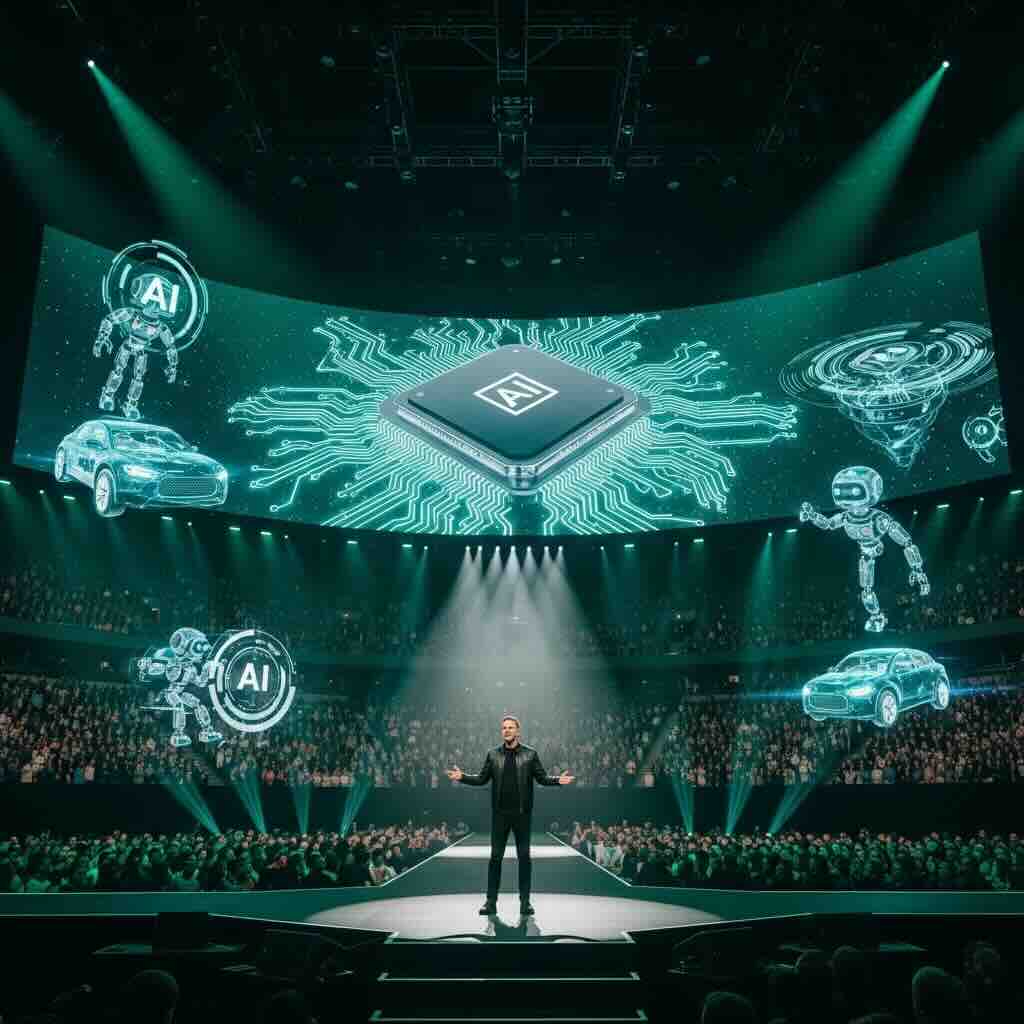
NVIDIA CEO Jensen Huang took the stage at the SAP Center in San Jose to a capacity crowd of thousands of attendees from more than 190 countries, delivering what may be the company's most consequential keynote in years. Over the course of a two-hour-plus presentation, Huang laid out a sweeping vision for the next era of artificial intelligence — one defined by agentic systems, physical robotics, and a staggering hardware roadmap that puts the company on course to surpass $1 trillion in cumulative orders by 2027.
Vera Rubin: The Next Frontier in AI Hardware
The headline hardware announcement was the full reveal of the Vera Rubin family of GPU and CPU systems, set to ship to customers later in 2026. Huang described Vera Rubin as a system made up of 1.3 million components, claiming it will deliver ten times more performance per watt than its predecessor, Grace Blackwell. The announcement confirms that NVIDIA's hardware ambition continues to scale at a pace that outstrips industry expectations.
Alongside Vera Rubin, Huang introduced the Groq 3 LPU (Language Processing Unit) — a complementary accelerator developed in partnership with Groq. The Groq 3 LPX rack is designed to hold 256 LPUs and sit beside the Vera Rubin rack-scale system. According to Huang, this pairing can boost tokens-per-watt performance of Rubin GPUs by as much as 35 times, effectively combining high-throughput and low-latency processing in a unified infrastructure.
Looking further ahead, Huang also briefly teased the Feynman family — slated for 2028 — which will introduce a new GPU, a new LPU, and a new CPU called Rosa. No detailed specifications were shared, but the roadmap signal alone was notable.
$1 Trillion in Orders: The Scale of the AI Infrastructure Boom
In perhaps the most striking financial disclosure of the keynote, Huang said NVIDIA now expects combined purchase orders for Blackwell and Vera Rubin to reach $1 trillion through 2027 — double the $500 billion opportunity the company had projected just one year ago. This figure reflects the explosive demand for AI infrastructure as companies race to deploy inference capacity at scale.
NVIDIA reported an anticipated revenue surge of approximately 77% year-over-year this quarter, to roughly $78 billion, continuing a streak of eleven consecutive quarters of revenue growth exceeding 55%. The company's market capitalization currently stands at approximately $4.5 trillion, making it one of the most valuable public companies in the world.
NemoClaw and the Agentic AI Moment
Huang devoted significant time to what he described as the "agentic AI moment" — a shift from prompt-based chatbot interactions to long-running autonomous systems that reason, plan, and take actions across complex workflows.
NVIDIA announced NemoClaw, an open-source stack pairing DGX Spark and DGX Station hardware with agentic AI software. The platform is designed to let enterprises and developers deploy always-on AI agents — referred to as "claws" — locally, without sending sensitive data to the cloud. NemoClaw is positioned as an enterprise-secure adaptation of OpenClaw, the rapidly growing open-source agentic platform created by developer Peter Steinberger, which Huang praised extensively during the keynote.
To further the open-source AI ecosystem, Huang also announced the Nemotron Coalition, a consortium that includes Perplexity, Reflection, Black Forest Labs, and other AI firms, aimed at advancing open frontier models.
"The ChatGPT Moment of Self-Driving Has Arrived"
Robotics and physical AI were a major focus of the second half of the keynote. Huang declared that "the ChatGPT moment of self-driving cars has arrived," signaling his belief that autonomous vehicles are on the cusp of mainstream deployment.
NVIDIA announced four new partners for robotaxi development, including BYD, Hyundai, and Nissan, along with a notable partnership with Uber to connect NVIDIA-powered robotaxis into Uber's ride network in select cities. The company showcased 110 robots at GTC across various commercial and industrial use cases, underscoring the breadth of its "physical AI" ambitions.
In a memorable moment, Disney's Olaf robot from Frozen walked on stage to join Huang — having been trained using NVIDIA simulation tools jointly developed with Disney — to demonstrate how physical AI models are moving from virtual training environments into real-world deployment.
DLSS 5: Generative AI Comes to Gaming
On the consumer side, NVIDIA unveiled DLSS 5 — the next generation of its Deep Learning Super Sampling technology. The new version uses generative AI and structured graphics data to dramatically improve photorealism in video games. Huang hinted that the underlying approach could eventually extend beyond gaming into other visual industries, though no specific announcements were made in that direction.
Space, AI Factories, and the Road Ahead
Huang also touched on Space-1, a Vera Rubin-based model intended to help bring data centers into orbit, though details remained sparse. He framed the global buildout of AI infrastructure as the "largest infrastructure rollout in history," introducing the NVIDIA DSX platform to help enterprises simulate, automate, and plan for AI-factory-scale deployments.
The keynote closed with a characteristically theatrical moment: an AI-generated country song, performed by animated robots and a Bitmoji-style version of Huang himself gathered around a campfire — singing about tokens, open-source software, and the future of technology.
NVIDIA GTC 2026 continues through March 19 at venues across downtown San Jose.