Anthropic’s FlashProve Turns Model Identity Into a Verifiable Computation
News Summary
Anthropic published FlashProve on November 2, 2026, as an open-source research prototype for proving that a particular model produced a given AI response. The project targets a growing verification problem: customers and auditors generally cannot tell from text alone whether a provider served the model it named. Anthropic’s benchmark suggests cryptographic verification can now be applied to a very large model, though the substantial proving overhead and prototype limitations leave real-world deployment unresolved.
What FlashProve is designed to prove
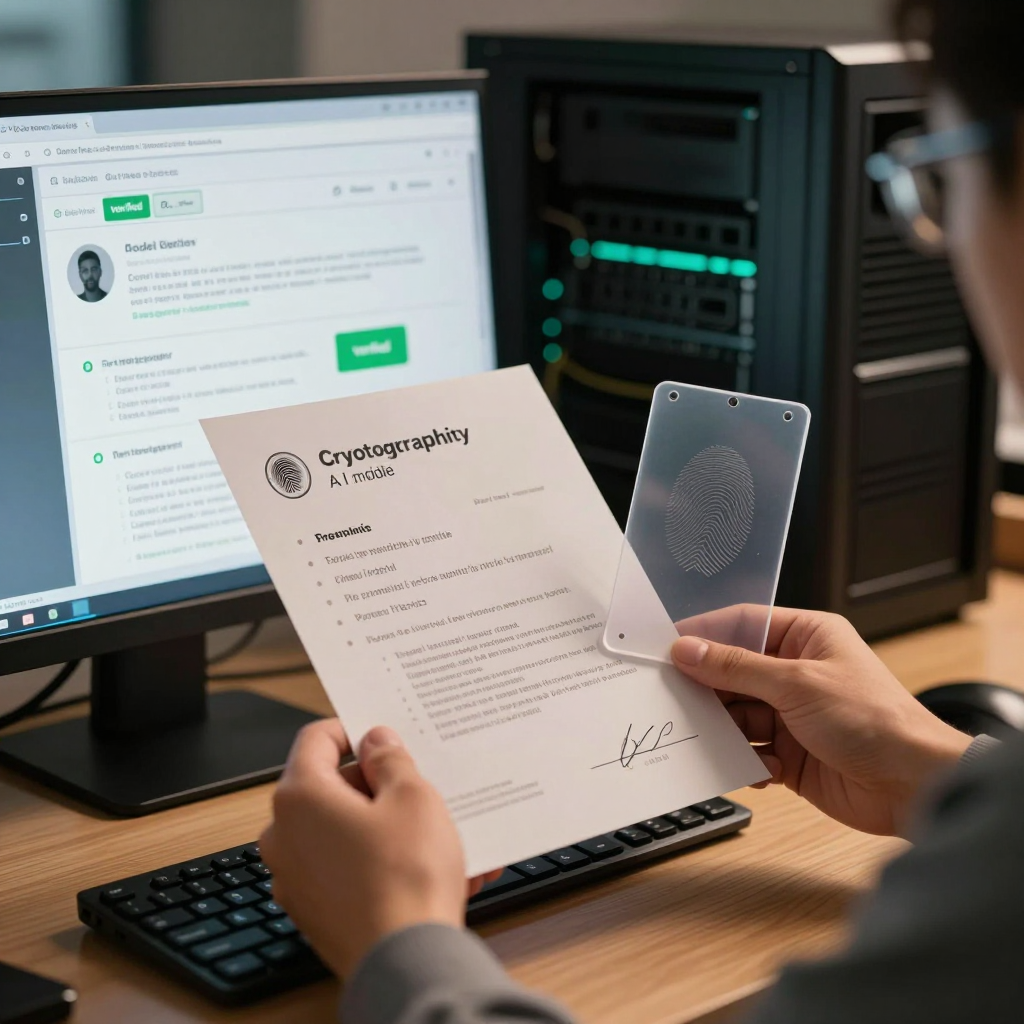
The system uses a zero-knowledge succinct non-interactive argument of knowledge, or zkSNARK. In an initial offline step, a provider publishes a compact commitment—a cryptographic fingerprint—to a specific set of model weights while keeping those weights private. For an inference request, it can then produce a proof asserting that the committed model generated the supplied output tokens for the supplied prompt. A verifier can check the claim without possessing the weights or rerunning the model.
This is closer to a signed receipt for computation than a way to judge whether an answer is correct or useful. A valid proof would bind the response to committed weights and a specific computation. It would not establish that the answer is true, that the model behaved safely, or that the provider’s model choice was appropriate. The approach is software-based and does not rely on trusted hardware.
Benchmark and engineering trade-offs
Anthropic tested FlashProve with Llama 4 Maverick, a 400-billion-parameter mixture-of-experts model, using publicly available 4-bit weights. On a server with one NVIDIA H100 GPU and 24 CPU cores, the prover handled a batch of 24 requests at about 110 tokens per second; each proof was approximately 18.78 MB. Verification ran on a CPU and took 17 seconds on 24 threads, or 21 seconds on one thread. Anthropic compares this to vLLM processing the same workload and reports that proving required roughly 72 times longer per GPU, rising to about 94 times at the highest tested load. These are company-reported prototype measurements, not a third-party audit or deployed service benchmark.
The system proves requests after the response rather than inline with generation. This permits a simpler proving pass but adds delay and compute: the provider must recompute or process the finished response to produce a certificate. The current demonstration covers contexts up to 1,024 tokens and uses a quantized integer model with greedy decoding. It does not automatically certify sampled or floating-point output if that output diverges from the exact computation being proved.
Why model provenance matters
Anthropic describes several possible uses: customers could check that a third-party router served the model they selected; evaluators could verify that model tests used the intended version; and organizations could substantiate claims that a particular model reviewed code or another consequential task. The same mechanism could help monitor commitments about which models a provider runs. It could also make model substitution more detectable, whether motivated by serving costs, evaluation claims, or a compromised inference service.
These are proposed uses, not current guarantees for customers. Proofs only mean something if the model commitment is published and trusted as the reference, and if the prover, verifier, and surrounding service integrate correctly. A fingerprint pins down a set of weights, but it is not by itself a public endorsement or safety assessment of those weights.
What the release includes—and what remains open
Anthropic’s November 2 research post includes a technical report, protocol specification, executable prover, C++ verifier, Lean verifier, and machine-checkable Lean statements for top-level security properties. The company says the code, proofs, and documentation are released under Apache 2.0. The GitHub repository identifies FlashProve as a research prototype and says it is not maintained. Anthropic characterizes the work as intermediate progress and invites outside researchers to examine and improve it; the company says it has no deployment plans for this system at Anthropic or another lab.
The research post also lays out important limits. The proof hides model weights, but not the architecture. The formal guarantees apply to specified mathematical statements, and Anthropic notes that auditors still need to check whether those statements match their intended claims and whether executable code implements the formal protocol. The fast C++ verifier does not carry the same formal guarantee as the Lean verifier. Other unresolved issues include possible information leakage through timing, scaling to longer contexts, and broadening support beyond the tested mixture-of-experts model and exact decoding setup.
Cross-check and significance
TechCrunch’s November 3, 2026 report describes FlashProve as a system for proving which model produced an output and highlights the possible risk of providers swapping models without users’ knowledge. Anthropic’s primary research post and its published technical materials support the core description, while adding a crucial qualification: this is an open research prototype with measurable but significant overhead, not an operational identity feature. The repo and report provide a starting point for independent technical scrutiny, but the published performance claims and security assumptions still need external evaluation in realistic deployments.
The wider educational point is that AI provenance can be framed as a verifiable computation problem. Cryptographic proofs may let a user check a narrow claim—“these tokens came from these committed weights under this computation”—without exposing proprietary weights. That could complement model cards, service logs, and independent evaluations, but it cannot replace them. The next milestones are practical integration, lower proving cost, longer-context support, and independent review of both the security model and implementation.
Sources
This article was compiled by the AIBARS editorial team with AI assistance. AI can make mistakes, so please check the original source for anything important. Spotted an error? Email [email protected].