ChatGPT, Claude and Grok All Went Down at the Same Time
News Summary
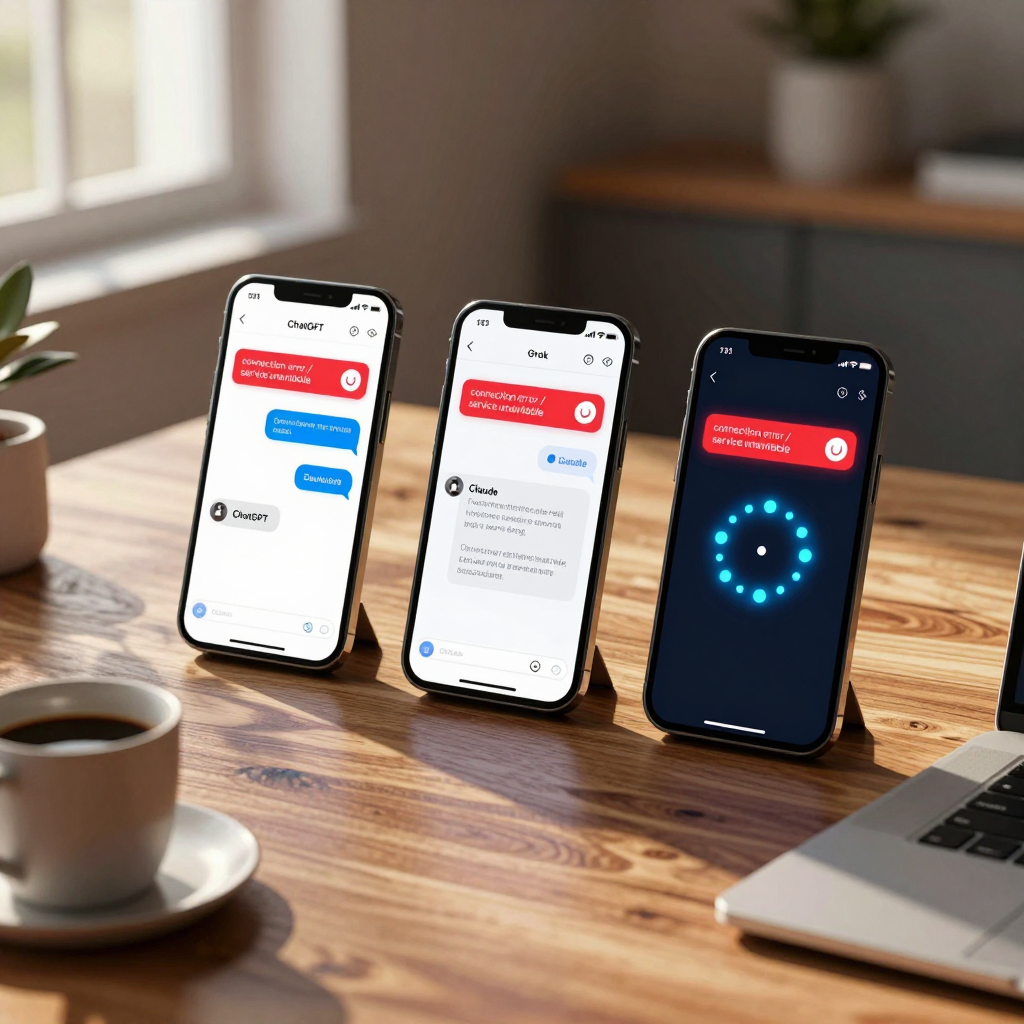
On Thursday, September 3, 2026, three of the world's most widely used AI chatbots — OpenAI's ChatGPT, Anthropic's Claude, and xAI's Grok — went down within the same window, sending outage reports surging across the United States and beyond. The near-simultaneous failure knocked out chat access for millions of everyday users and disrupted developer tools that depend on these models behind the scenes, reviving a now-familiar reminder of how much daily work and communication has come to rely on a small handful of AI providers.
What Happened
Outage-tracking reports began climbing sharply shortly after 9:00 a.m. Eastern Time. According to Downdetector, ChatGPT amassed more than 37,000 user reports by around 11:00 a.m. Eastern Time, making it by far the most affected service. Grok reports peaked at roughly 1,365 close to 10:00 a.m. Eastern Time, while Claude reports peaked at about 1,324 just before 11:00 a.m. Eastern Time. Google's Gemini also saw a smaller spike, with around 500 reports by 11:00 a.m. Eastern Time, though Google did not confirm an official outage.
Users described being unable to load conversations, send new messages, or receive responses at all, with web, mobile, and desktop versions of the affected apps impacted. The disruption also rippled into developer-facing tools: the AI coding assistant Cursor reported problems that it attributed to the underlying Claude and Grok failures it depends on, illustrating how outages at the model layer can cascade into unrelated products built on top of them.
Possible Common Cause
The fact that three unrelated companies suffered outages at virtually the same time quickly drew attention to shared cloud infrastructure. Multiple outlets noted that Microsoft Azure also recorded an elevated number of outage reports during the same period, and pointed out that OpenAI, Anthropic, and xAI all rely on Azure or Azure-adjacent infrastructure for at least part of their cloud computing needs. None of the companies had, at the time of reporting, published a confirmed root-cause explanation tying the incidents directly to Azure, and the connection remained circumstantial rather than officially verified.
Company Responses and Recovery
Each company acknowledged problems on its own status page. OpenAI's status page reported "issues across ChatGPT and Codex" and said a fix had been applied, with services beginning to recover by around 8:49 a.m. Pacific Time. Anthropic's status page indicated that "Claude is experiencing elevated errors," and the company later said most Claude models had returned to normal, though Opus 4.8 and Opus 5 lagged behind the rest of the fleet during the initial recovery window. Anthropic developer relations engineer CJ Avilla later confirmed that "all Claude models are back to normal." Grok's status page acknowledged the service was "currently experiencing issues," though xAI provided fewer public details on the recovery timeline than OpenAI or Anthropic.
For most users, the disruption lasted roughly 30 to 45 minutes before core functionality began returning, though scattered reports of elevated error rates continued for some time afterward as each provider worked through a full recovery.
Timing and Speculation
The outage's timing drew extra attention because it coincided with growing anticipation of a major OpenAI model announcement, widely rumored to be a new flagship model referred to as "Astra." OpenAI's and ChatGPT's official social media accounts had posted cryptic teaser messages such as "the stars are almost aligned" in the days leading up to the outage, fueling online speculation about whether the incident was linked to backend changes tied to an imminent launch. No company confirmed any connection between the outage and unreleased model work, and the simultaneous timing across three separate companies is widely viewed as coincidental rather than related to any single product rollout.
Why It Matters
Incidents like this highlight a structural reality of the current AI landscape: despite fierce competition between OpenAI, Anthropic, and xAI, their services often sit on overlapping cloud infrastructure providers, meaning a single upstream problem can degrade multiple "competing" products at once. For consumers and businesses that have built workflows, customer support systems, or coding pipelines around AI chat assistants, the outage was a concrete reminder to plan for redundancy rather than assuming any single AI service will always be available. Industry observers noted that as AI tools become embedded more deeply into daily productivity software, browsers, and developer environments, the operational stakes of these shared dependencies will only grow.