Intel and Google Sign Multiyear AI Infrastructure Deal — Xeon CPUs and Custom IPUs Take Center Stage
News Summary
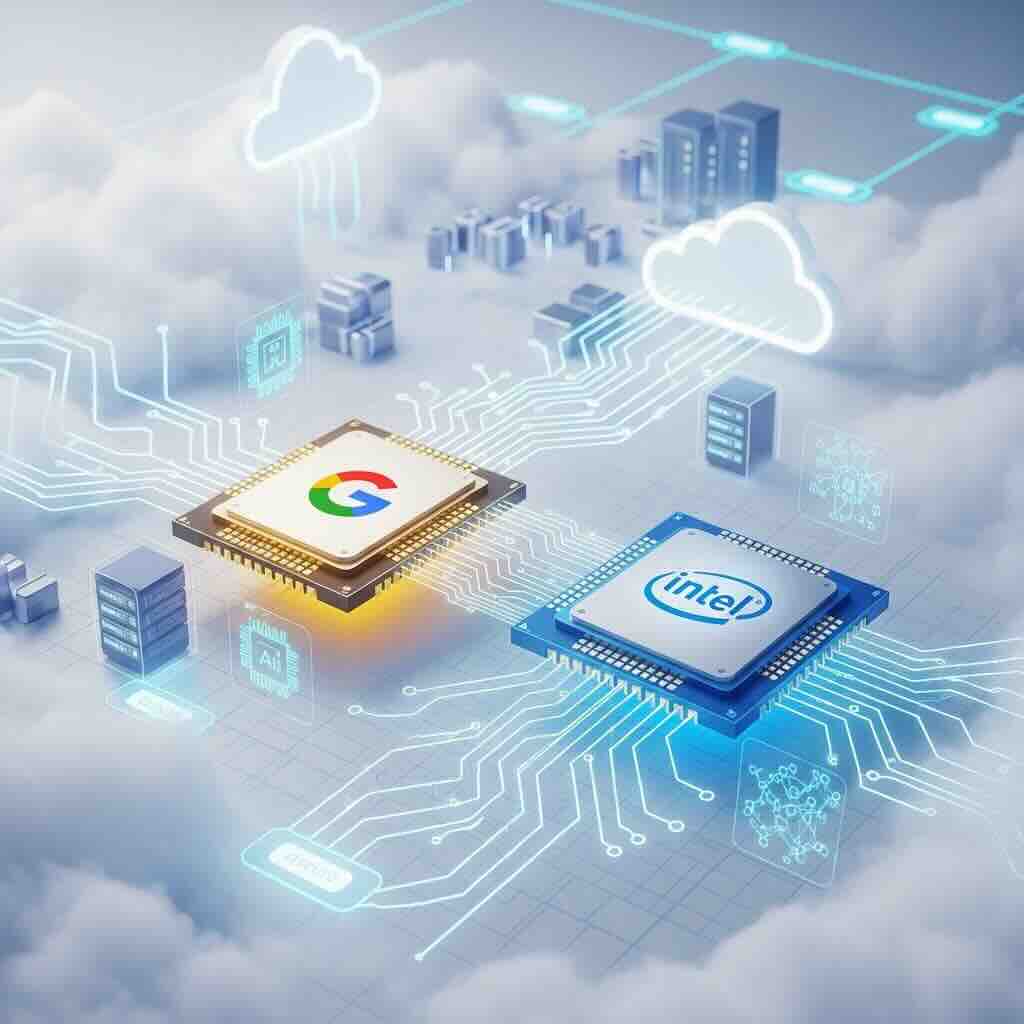
Intel Corporation and Alphabet's Google announced on April 9, 2026 (EDT) a multiyear collaboration to advance the next generation of AI and cloud infrastructure. The partnership covers two key areas: Google Cloud's continued multi-generational deployment of Intel Xeon processors — including the latest Xeon 6 chips — and the expanded co-development of custom ASIC-based Infrastructure Processing Units (IPUs) designed to offload networking, storage, and security tasks from host CPUs. The deal reflects a broader industry shift toward balanced, heterogeneous AI compute systems, as workloads move from model training toward real-world inference and deployment at scale. Intel shares rose nearly 5% on the announcement.
Background: The Evolution of AI Infrastructure
For years, the AI chip conversation revolved almost exclusively around GPUs — the massively parallel processors that power the training of large language models. But by 2026, the industry has entered a new phase. The focus has shifted from building AI models to deploying them at scale, and that shift is fundamentally changing what kinds of chips matter most. Inference workloads, real-time data processing, agentic AI systems, and enterprise-grade deployment all demand a broader mix of compute — including traditional central processing units (CPUs) and custom infrastructure chips.
It is against this backdrop that Intel Corporation (NASDAQ: INTC) and Alphabet's Google announced, on April 9, 2026 (EDT), a significant multiyear collaboration to advance the next generation of AI and cloud infrastructure.
What Was Announced
The partnership has two major pillars.
The first involves Intel's flagship Xeon processor line. Google Cloud has committed to deploying multiple generations of Intel Xeon processors across its global infrastructure, covering AI training coordination, inference, and general-purpose computing workloads. Google currently runs Intel's latest Xeon 6 processors in its C4 and N4 cloud instances — platforms designed to handle everything from latency-sensitive AI inference to large-scale data processing. "Their Xeon roadmap gives us confidence that we can continue to meet the growing performance and efficiency demands of our workloads," said Amin Vahdat, Google's Senior Vice President and Chief Technologist for AI Infrastructure.
The second pillar involves the co-development of custom ASIC-based Infrastructure Processing Units, commonly known as IPUs. These are specialized programmable chips designed to offload specific infrastructure tasks — such as networking, storage management, data encryption, and virtualization — from the main CPU. By taking over these "overhead" functions, IPUs free up CPU resources for higher-value computation, resulting in better overall system utilization, more efficient energy use, and more predictable performance at hyperscale. Google noted that the IPU was a first-of-its-kind chip when the two companies first began collaborating on it back in 2022.
Why CPUs Are Back in the Spotlight
A key theme of this announcement is the renewed strategic importance of CPUs in AI systems. While GPUs — particularly those from Nvidia — have dominated the AI training market, the compute landscape is becoming more complex and heterogeneous.
As Nvidia's own head of AI infrastructure, Dion Harris, acknowledged in March 2026, CPUs are "becoming the bottleneck" as agentic AI workloads push compute demands beyond what GPUs alone can handle. Intel CEO Lip-Bu Tan echoed this sentiment: "Scaling AI requires more than accelerators — it requires balanced systems. CPUs and IPUs are central to delivering the performance, efficiency and flexibility modern AI workloads demand."
Modern AI architectures — especially those involving agentic systems that autonomously perform multi-step tasks — require substantial CPU-side orchestration. A single enterprise AI agent may trigger dozens of CPU-driven operations for every GPU inference step. This makes robust, high-performance CPU infrastructure increasingly essential.
Intel's Broader Strategic Momentum
The Google partnership does not exist in isolation. Intel has been making a series of moves to strengthen its position in the AI infrastructure market.
Earlier in April 2026, Intel announced a $14.2 billion deal to repurchase a 49% equity stake in its Fab 34 manufacturing facility in Ireland from Apollo Global Management. The Fab 34 facility is a high-volume semiconductor fabrication site and a key production center for Intel's Xeon 6 server processors. Taking full ownership of the facility signals Intel's commitment to controlling its supply chain and manufacturing capacity for critical AI chips.
Additionally, Intel announced its participation in the Terafab AI chip complex project — a consortium that also includes SpaceX and Tesla — aimed at building next-generation chip infrastructure for robotics and advanced data centers.
Financial markets responded positively to the Google collaboration announcement. Intel shares gained nearly 5% on April 9 (EDT), with the stock trading around $59.38. KeyBanc raised its price target for Intel to $70, maintaining an Overweight rating, citing strong server CPU demand.
Technical Deep Dive: Understanding IPUs
For readers less familiar with the terminology, an Infrastructure Processing Unit (IPU) is distinct from both a CPU and a GPU. While CPUs handle general computation and GPUs excel at parallel mathematical operations for AI model training, IPUs are purpose-built to manage the "plumbing" of a data center — the continuous flow of data across networks, the management of storage systems, the encryption of data in transit, and the orchestration of virtualized environments.
In a traditional data center, all of these infrastructure tasks consume a significant portion of the main CPU's processing capacity, leaving less available for actual application workloads. By offloading these functions to a dedicated IPU, the host CPU is freed to focus on higher-value tasks, increasing overall system efficiency. For hyperscale cloud providers like Google, which operate millions of servers worldwide, even modest improvements in per-server efficiency translate into enormous cost savings and performance gains.
What This Means for the Industry
The Google-Intel collaboration reflects a broader industry-wide recognition that AI infrastructure is becoming more sophisticated and multi-layered. The era of single-chip AI dominance — where GPU clusters alone defined the state of the art — is giving way to a more balanced, heterogeneous compute model that integrates CPUs, GPUs, custom accelerators, and infrastructure chips.
For cloud customers and enterprise developers, this means that the underlying infrastructure powering AI services is becoming more capable, more efficient, and better optimized for the diverse workloads of production AI. For the semiconductor industry, it signals that the competitive landscape extends well beyond the GPU market, with CPUs and custom infrastructure chips playing an increasingly central role.
Google itself continues to maintain a diverse silicon strategy. In addition to its Intel Xeon deployments, Google has developed its own Tensor Processing Units (TPUs) for AI acceleration and, since 2024, its custom Axion CPU — an Arm-based processor — for certain cloud workloads. The continued reliance on Intel Xeon processors alongside these proprietary chips underscores the scale and complexity of Google's infrastructure needs.
Looking Ahead
No financial terms or specific purchase commitments were disclosed as part of the April 9 announcement. However, the multiyear, multi-generational nature of the agreement suggests a long-term strategic alignment between the two companies that extends well beyond a single product cycle.
As AI continues to evolve from experimental technology to the backbone of enterprise and consumer services, the infrastructure that supports it will become an increasingly critical competitive differentiator. Partnerships like the one between Google and Intel are helping to define what that infrastructure will look like — and who will build it.