Google Gemma 4 Arrives With Apache 2.0 License and Top-3 Open Model Ranking
News Summary
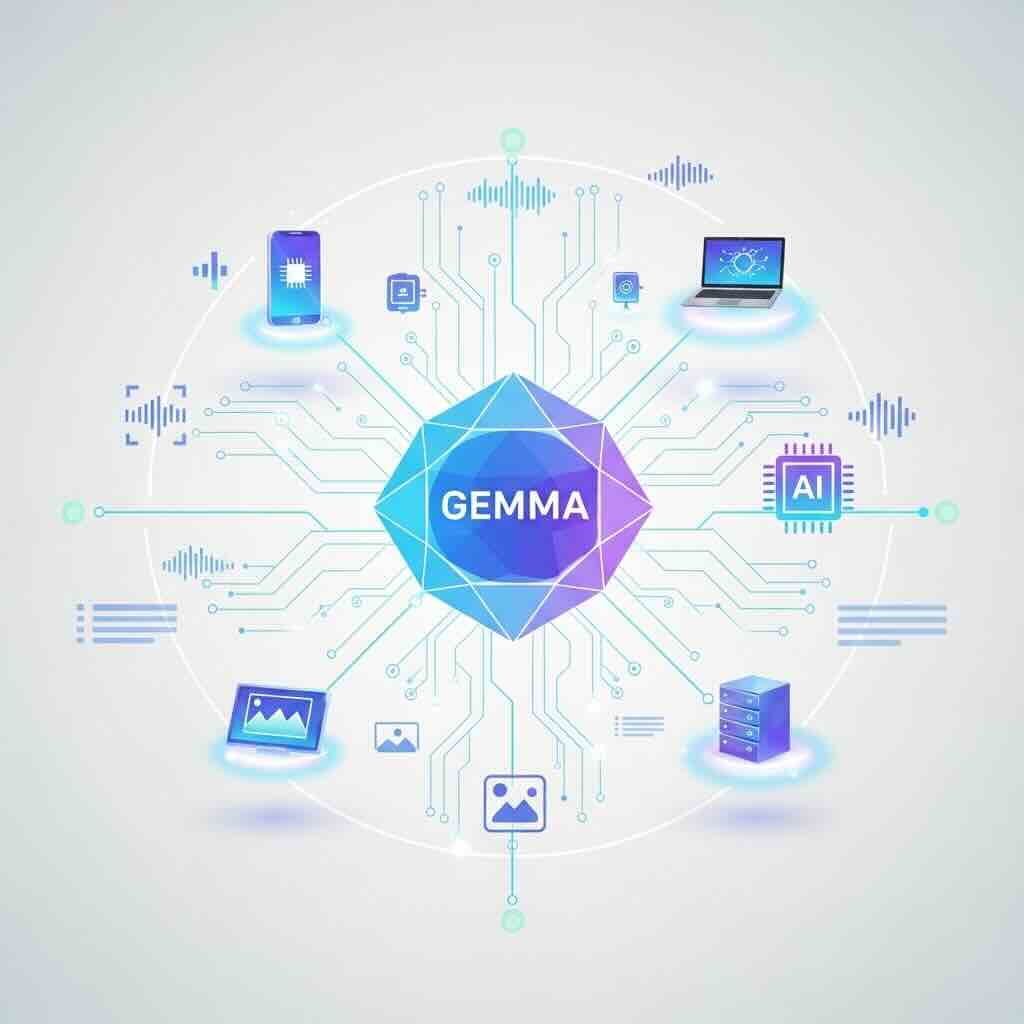
April 2, 2026 (ET) — Google officially announced the release of Gemma 4, its most powerful open model family to date. Built on the same foundational research and technology as Google's proprietary Gemini 3, Gemma 4 marks a significant milestone in the open AI ecosystem — bringing enterprise-grade intelligence to devices ranging from smartphones to high-performance workstations.
Four Model Sizes for Every Use Case
Gemma 4 is offered in four distinct configurations, each tailored to different hardware capabilities and performance needs:
E2B (Effective 2 Billion Parameters) is the most compact variant, engineered for maximum speed and ultra-low latency on edge hardware. It supports a 128K token context window, runs on Android phones, Raspberry Pi, and NVIDIA Jetson Orin Nano, and uniquely supports audio input alongside text and image processing.
E4B (Effective 4 Billion Parameters) offers stronger reasoning power while remaining optimized for mobile and embedded devices. Like the E2B, it features a 128K context window and multimodal support including audio. Google reports that the E4B is up to 4x faster than previous-generation models and uses up to 60% less battery — a notable achievement for on-device AI applications.
26B MoE (Mixture-of-Experts) is a 26-billion parameter model that activates only 3.8 billion parameters at inference time, enabling fast token generation on consumer GPUs and workstations. It supports a 256K context window and is currently ranked 6th among all open models on the Arena AI Text Leaderboard.
31B Dense is Gemma 4's flagship model, designed for maximum output quality. With a 256K token context window, it fits within a single 80 GB NVIDIA H100 GPU in its native bfloat16 format. Quantized versions can also run on consumer graphics cards. It currently ranks 3rd worldwide among all open models on the Arena AI leaderboard — a significant achievement for an open-weight model of this caliber.
A First: Apache 2.0 License for Commercial Use
One of the most impactful announcements in the Gemma 4 release is the adoption of the Apache 2.0 license — a first for the Gemma model family. Previous Gemma versions were released under a more restrictive Google proprietary license.
The Apache 2.0 license grants developers complete freedom to use, modify, and deploy the models in commercial applications without royalty obligations. This shift positions Gemma 4 as a serious contender in the enterprise open-source AI space, offering developers full control over their data, infrastructure, and deployment environments — whether on-premises or in the cloud.
Performance That Punches Above Its Weight
Google claims that Gemma 4 models consistently outperform competitors up to 20 times their parameter size. Benchmark data released alongside the announcement supports this assertion across several standard evaluations:
On AIME 2026 (advanced mathematics), the Gemma 4 31B model achieved an impressive 89.2% score, compared to just 20.8% for Gemma 3 27B. On LiveCodeBench v6 (competitive programming), the 31B model scored 80.0%, while the smaller E4B and E2B variants scored 52.0% and 44.0% respectively — strong results for models designed to run on consumer-grade hardware. On GPQA Diamond (scientific reasoning), the 31B achieved 84.3%, again substantially outpacing its predecessor.
Built for Agentic AI Workflows
Beyond raw benchmark performance, Gemma 4 is designed with agentic applications in mind. All model sizes natively support function calling, structured JSON output, and system instructions — capabilities that allow AI agents to coordinate across multiple tools and APIs without manual orchestration.
Google describes the full range of Gemma 4 applications as spanning "from simple chat to complex logic and agentic workflows," making the model family suitable for everything from personal assistant apps to automated software pipelines.
Multilingual and Multimodal by Default
Gemma 4 natively supports over 140 languages, which Google states enables "improved localized, multilingual experiences for global audiences." On the multimodal side, all four model variants support vision input (images and video), while the E2B and E4B edge models additionally support audio input — making them among the most capable small models available for real-world multimodal tasks.
Android Integration and Developer Access
Google's Android Developers Blog confirmed on April 2, 2026 (ET) that Gemma 4 will serve as the foundation for the next generation of Gemini Nano, the on-device AI powering Android smartphones. Code written for Gemma 4 today will be compatible with future Gemini Nano 4-enabled devices, easing the path from development to production.
Developers can access Gemma 4 via multiple channels. The 31B and 26B MoE models are available in Google AI Studio. The edge E4B and E2B models can be tested via the AI Edge Gallery app. Model weights are freely downloadable from Hugging Face, Kaggle, and Ollama. Android developers can also opt into the AICore Developer Preview to run models directly on supported devices, leveraging specialized AI accelerators from Google, MediaTek, and Qualcomm Technologies.
Industry Ecosystem Support
The release has already attracted support from key industry partners. NVIDIA announced optimizations for Gemma 4 across its RTX PC lineup and DGX Spark hardware, focusing on local agentic AI use cases. Qualcomm and MediaTek collaborated with Google on the edge model variants to ensure efficient inference on mobile SoCs.
Where to Get Gemma 4
Gemma 4 model weights are available now through the following platforms:
Hugging Face, Kaggle, and Ollama all host downloadable model weights. Google AI Studio provides hosted access to the 26B MoE and 31B Dense models. The AI Edge Gallery app offers mobile-optimized access to the E2B and E4B variants. Android developers can register for the AICore Developer Preview for on-device testing.
Closing Perspective
The release of Gemma 4 underscores a broader trend in the AI industry: capable, production-ready AI models are increasingly accessible outside of proprietary cloud services. With Apache 2.0 licensing, broad hardware compatibility, strong benchmark performance, and multimodal capabilities built in, Gemma 4 represents a meaningful step forward for developers, researchers, and organizations seeking powerful AI tools they can deploy and customize on their own terms.