NVIDIA Unveils Nemotron 3: Revolutionary Open Model Family Powers Next-Generation Agentic AI Development
News Summary
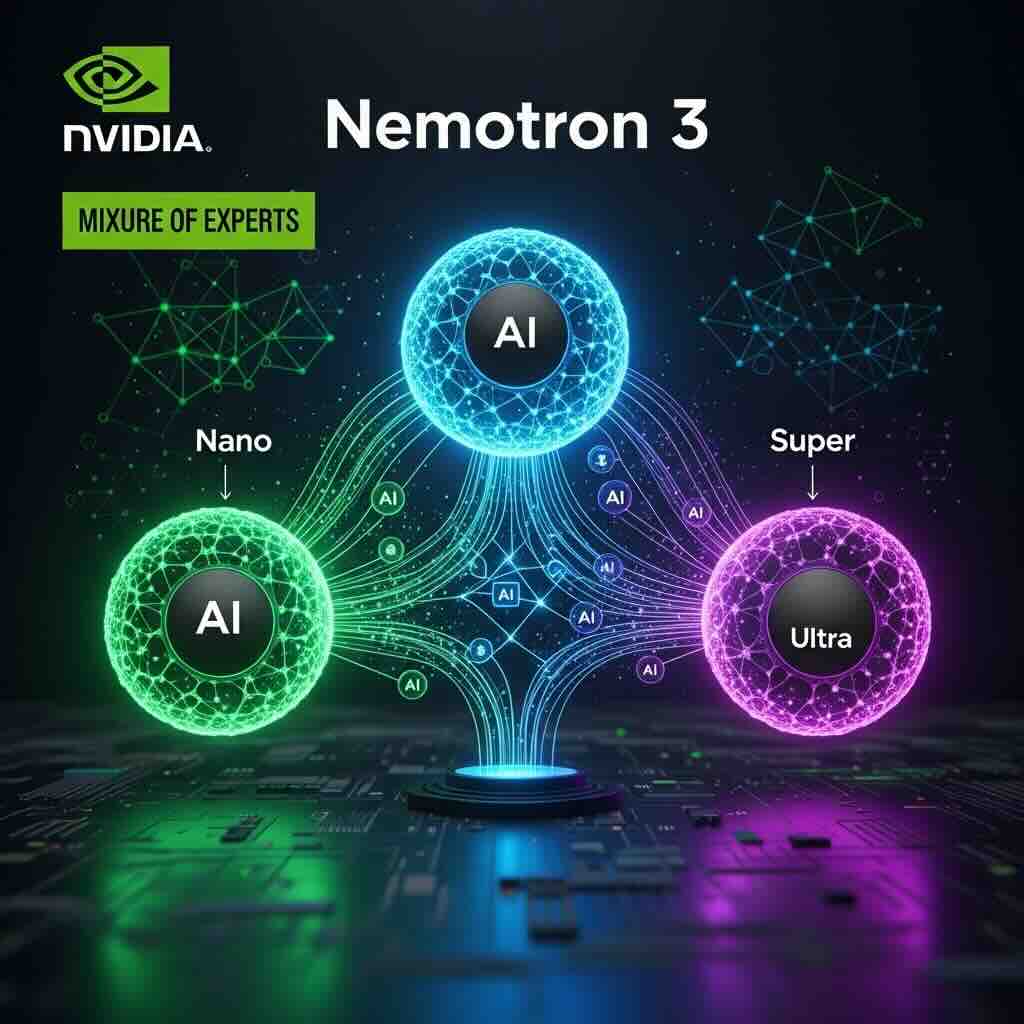
NVIDIA has launched the Nemotron 3 family of open models, representing a significant advancement in agentic AI development. The three-tiered model family—Nano, Super, and Ultra—introduces breakthrough hybrid mixture-of-experts architecture designed to address the mounting challenges developers face as organizations transition from single-model chatbots to sophisticated multi-agent AI systems.
The announcement, made on December 15, 2025, marks NVIDIA's commitment to open innovation in artificial intelligence. CEO Jensen Huang emphasized that Nemotron transforms advanced AI into an open platform, providing developers with the transparency and efficiency required for building agentic systems at scale.
Groundbreaking Architecture Powers New Efficiency Standards
The Nemotron 3 family employs an innovative hybrid latent mixture-of-experts architecture that fundamentally reimagines how AI models handle complex, multi-step tasks. This architectural approach allows the models to activate only necessary parameters for specific tasks, dramatically improving computational efficiency while maintaining or exceeding accuracy benchmarks.
NVIDIA's engineering team achieved remarkable performance gains with this design. The Nano model, despite being the smallest in the family, delivers throughput improvements that exceed its predecessor by a factor of four. This translates to tangible cost savings for enterprises deploying multi-agent systems, with reasoning-token generation costs reduced by up to 60 percent.
The hybrid architecture combines transformer technology with selective parameter activation, enabling the models to scale effectively across different workload requirements. This flexibility allows developers to match model size and capability precisely to their application needs, from lightweight assistant tasks to complex strategic planning workflows.
Three-Tiered Approach Addresses Diverse Enterprise Needs
Nemotron 3 Nano: Efficiency at Scale
Available immediately, Nemotron 3 Nano establishes new benchmarks for compute-cost efficiency in the open model landscape. With 30 billion total parameters activating just 3 billion at any given time, the model excels at targeted applications including software debugging, content summarization, AI assistant workflows, and information retrieval.
Artificial Analysis, an independent AI benchmarking organization, ranked Nemotron 3 Nano as the most open and efficient model in its size class. The model supports an impressive 1-million-token context window, enabling it to maintain coherence and accuracy across extended multi-step reasoning tasks—a critical capability for agentic applications that require sustained contextual understanding.
The throughput improvements delivered by Nano are particularly significant for organizations operating multi-agent systems where token generation speed directly impacts user experience and operational costs. Early testing demonstrates the model's ability to handle high-volume concurrent requests without degradation in response quality.
Nemotron 3 Super: Collaborative Intelligence
Scheduled for release in the first half of 2026, Nemotron 3 Super targets applications requiring numerous collaborating agents operating with minimal latency. With approximately 100 billion parameters and 10 billion active per token, Super is optimized for scenarios such as IT ticket automation, customer service orchestration, and complex workflow management.
The model employs NVIDIA's ultraefficient 4-bit NVFP4 training format on Blackwell architecture, significantly reducing memory requirements while maintaining accuracy levels comparable to higher-precision formats. This efficiency breakthrough enables organizations to deploy larger models on existing infrastructure without costly upgrades.
Nemotron 3 Ultra: Advanced Reasoning Engine
The flagship model in the family, Nemotron 3 Ultra features approximately 500 billion parameters with up to 50 billion active per token. Also slated for first-half 2026 availability, Ultra serves as a sophisticated reasoning engine for AI workflows demanding deep research capabilities and strategic planning support.
Ultra's design supports complex decision-making scenarios where thoroughness and analytical depth take precedence over response speed. The model's architecture enables it to process extensive information sets, identify patterns across disparate data sources, and generate comprehensive analytical outputs.
Comprehensive Ecosystem Supports Rapid Development
NVIDIA's release extends far beyond the models themselves, encompassing a complete development ecosystem designed to accelerate specialized AI agent creation. The company released three trillion tokens of training data spanning pretraining, post-training, and reinforcement learning datasets—an unprecedented resource for the developer community.
These datasets provide the foundation for creating domain-specialized agents with capabilities tailored to specific industry requirements. The collections include rich examples of reasoning patterns, coding workflows, and multi-step task execution strategies that developers can leverage to train models aligned with their unique use cases.
The Nemotron Agentic Safety Dataset addresses a critical gap in AI development by providing real-world telemetry data for evaluating and strengthening agent system safety. As organizations deploy increasingly autonomous AI systems, robust safety evaluation frameworks become essential for maintaining trust and regulatory compliance.
NVIDIA also released NeMo Gym and NeMo RL, open-source libraries that provide training environments and post-training infrastructure specifically designed for reinforcement learning workflows. These tools, combined with NeMo Evaluator for safety and performance validation, create an integrated development environment that significantly reduces the complexity of building production-ready agentic systems.
Industry Adoption Signals Market Confidence
Major enterprises across diverse sectors are already integrating Nemotron models into their operations. Accenture, Deloitte, and EY are exploring applications in professional services, while technology leaders including Oracle Cloud Infrastructure, ServiceNow, and Zoom are incorporating the models into their platforms.
ServiceNow CEO Bill McDermott highlighted the partnership's potential to define new standards in agentic AI implementation. The combination of ServiceNow's intelligent workflow automation with Nemotron 3's capabilities creates opportunities for unprecedented efficiency and accuracy in enterprise operations.
Perplexity, a leader in AI-powered search and research, announced plans to use an agent router architecture that directs workloads between Nemotron 3 Ultra for specialized tasks and proprietary models where their unique capabilities provide advantages. This hybrid approach optimizes the balance between performance, cost, and specialized functionality.
The startup ecosystem is also embracing Nemotron 3 as a foundation for innovation. Portfolio companies of General Catalyst, Mayfield, and Sierra Ventures are exploring applications of the models to build AI teammates supporting human-AI collaboration across various domains.
Sovereign AI and Global Deployment Strategy
Nemotron 3 supports NVIDIA's broader sovereign AI initiative, enabling nations and regions to develop AI systems aligned with local data governance requirements, regulatory frameworks, and cultural values. Organizations across Europe and South Korea are adopting the open, transparent models to build AI infrastructure that maintains data sovereignty while leveraging cutting-edge capabilities.
This approach addresses growing global concerns about AI governance and data privacy. By providing fully open models that organizations can deploy within their own infrastructure, NVIDIA enables entities to maintain complete control over their AI systems while benefiting from state-of-the-art model architectures and training methodologies.
The sovereign AI strategy also supports economic development initiatives, allowing regions to build domestic AI capabilities rather than depending entirely on foreign cloud services. This localization of AI development and deployment creates opportunities for regional innovation ecosystems to flourish.
Accessible Deployment Options Accelerate Adoption
NVIDIA has ensured broad accessibility for Nemotron 3 Nano through partnerships with leading inference service providers. The model is immediately available through Baseten, DeepInfra, Fireworks, FriendliAI, OpenRouter, and Together AI, providing developers with multiple deployment options suited to different operational requirements and budget constraints.
Enterprise AI and data infrastructure platforms including Couchbase, DataRobot, H2O.ai, JFrog, Lambda, and UiPath have integrated support for Nemotron models. This widespread platform adoption reduces integration friction and enables organizations to incorporate the models into existing workflows with minimal disruption.
Public cloud availability expands the model's reach further. AWS will offer Nemotron 3 Nano through Amazon Bedrock's serverless infrastructure, while Google Cloud, CoreWeave, Crusoe, Microsoft Foundry, and other major cloud providers will support the model in their platforms. This multi-cloud strategy ensures organizations can deploy Nemotron models within their preferred cloud environments.
For enterprises requiring maximum control and privacy, NVIDIA offers Nemotron 3 Nano as an NVIDIA NIM microservice. This packaging enables secure, scalable deployment on NVIDIA-accelerated infrastructure, whether on-premises or in private cloud environments, ensuring sensitive workloads remain within organizational boundaries.
Technical Innovation Drives Performance Leadership
The technical innovations underlying Nemotron 3's performance extend beyond the headline architectural features. NVIDIA's engineering team employed advanced reinforcement learning techniques with concurrent multi-environment post-training at scale—a methodology that exposes models to diverse scenarios during training, improving their ability to generalize across different real-world applications.
Multi-token prediction capabilities in the Super and Ultra models enhance long-form text generation efficiency while improving overall model quality. This feature enables the models to plan ahead during generation, producing more coherent and contextually appropriate outputs for extended responses.
The 4-bit NVFP4 training format represents a significant advancement in training efficiency. By reducing numerical precision requirements without sacrificing model accuracy, NVIDIA has made it possible to train larger models on existing hardware configurations. This democratizes access to frontier-model capabilities by lowering the infrastructure requirements for model development.
Granular reasoning budget control at inference time provides developers with fine-grained control over model behavior. This feature enables dynamic adjustment of computational resources allocated to different queries, optimizing the balance between response quality and inference cost based on specific application requirements.
Open Source Commitment Strengthens Developer Ecosystem
NVIDIA's decision to release comprehensive training data, model weights, and development tools under open licenses reflects a strategic commitment to fostering innovation through community collaboration. The company is making available not only the final trained models but also base models and training recipes, enabling researchers and developers to understand and build upon NVIDIA's work.
The release includes Nemotron 3 Nano in both FP8 quantized and BF16 precision formats, along with the base pre-trained model. This transparency supports reproducibility and allows the research community to validate NVIDIA's claims while exploring alternative training approaches and model variants.
Integration support from tools like LM Studio, llama.cpp, SGLang, and vLLM ensures developers can incorporate Nemotron models into their existing development workflows without adopting entirely new toolchains. Prime Intellect and Unsloth are integrating NeMo Gym's training environments directly into their platforms, further reducing barriers to advanced reinforcement learning experimentation.
Future Outlook and Industry Implications
The Nemotron 3 release signals a maturation of the open model landscape, demonstrating that transparency and commercial-grade performance are not mutually exclusive. As organizations increasingly recognize the strategic importance of AI capabilities, the ability to deploy, customize, and control models becomes a critical competitive factor.
The scheduled 2026 release of Super and Ultra models will complete the Nemotron 3 family, providing enterprises with options spanning the full spectrum of capability and efficiency requirements. This tiered approach enables organizations to implement hybrid deployment strategies that optimize cost while maintaining performance where it matters most.
NVIDIA's integrated ecosystem approach—combining models, data, and tools in a cohesive package—establishes a new standard for open model releases. Rather than simply publishing model weights, the company is providing the complete infrastructure required for successful deployment and customization.
The emphasis on agentic AI capabilities positions Nemotron 3 at the forefront of an emerging paradigm shift in AI application architecture. As single-model chatbots give way to collaborative multi-agent systems, models specifically designed for this use case will likely gain significant traction across enterprise deployments.
Industry analysts expect the open nature of Nemotron 3 to accelerate innovation in specialized AI applications, particularly in domains where data privacy, regulatory compliance, or unique industry requirements make proprietary cloud models impractical. The combination of leading-edge capabilities with complete transparency creates opportunities for customization and domain adaptation previously achievable only with extensive in-house AI development teams.