Google Announces Project Suncatcher: Sending AI Chips into Orbit to Pioneer a New Era of Computing
Abstract
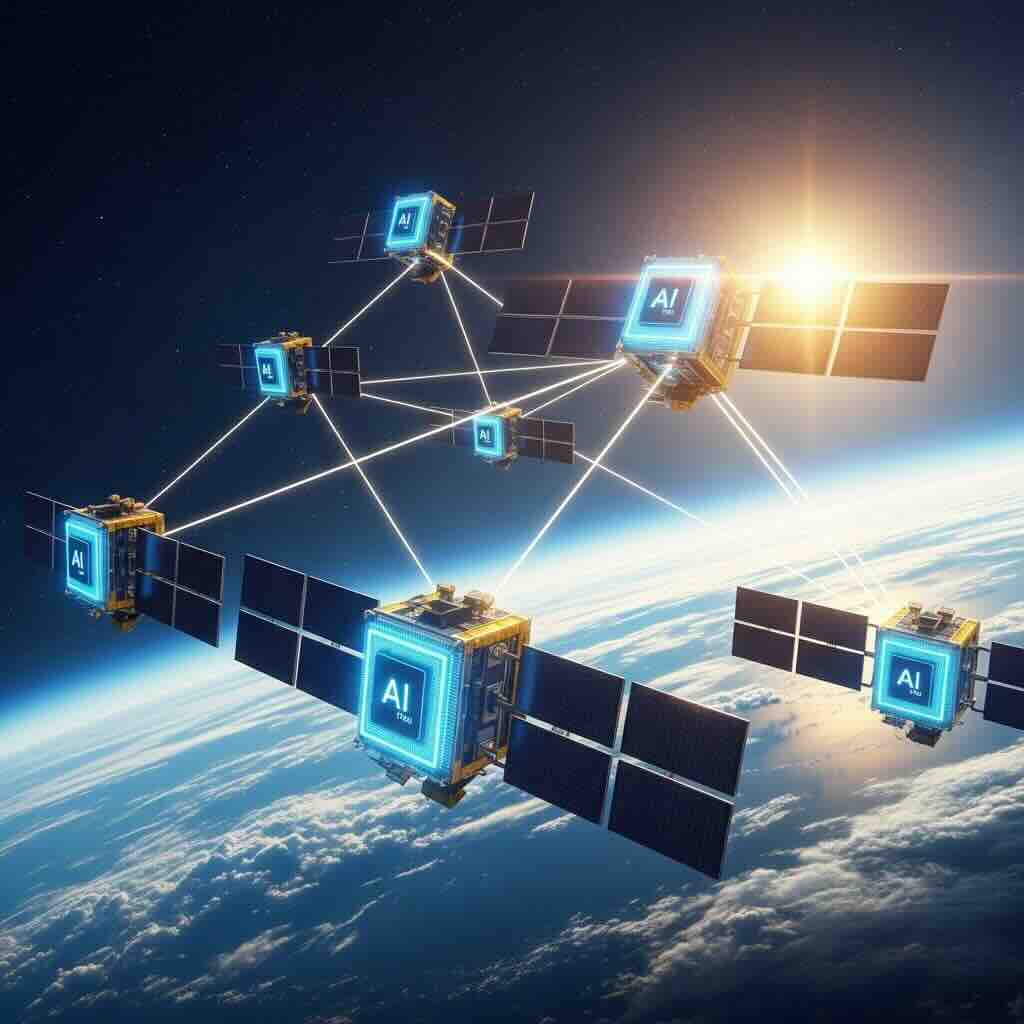
On November 4, 2025 (Eastern Time), Google unveiled its "Project Suncatcher" research initiative, aiming to deploy solar-powered satellites equipped with TPU chips into orbit to construct an AI data center in space. The company plans to launch two test satellites in collaboration with Planet Labs in 2027, each carrying four TPU chips. This innovative approach marks a significant attempt to extend AI infrastructure from Earth into space, targeting the energy consumption and carbon emissions challenges associated with terrestrial data centers.
AI Computing Moves Toward Space: Google Proposes Solar-Powered Satellite Data Centers
On November 4, 2025 (Eastern Time), Google officially announced its cutting-edge research project, "Project Suncatcher," led by Travis Beals, Senior Director of Google's AI Paradigms team. The project proposes deploying Google’s Tensor Processing Unit (TPU) AI chips onto solar-powered satellites to establish machine learning computing infrastructure in space.
Technical Approach and Innovations
The system design employs compact satellite constellations operating in dawn-dusk Sun-synchronous low Earth orbit (SSO), ensuring near-continuous exposure to sunlight. At suitable orbital altitudes, solar panels can achieve up to eight times the power generation efficiency compared to ground-based installations and generate electricity almost continuously, significantly reducing battery requirements.
To match the performance of terrestrial data centers, inter-satellite links must support bandwidths of tens of terabits per second. Google’s team has experimentally demonstrated feasibility, achieving 1.6 terabits per second using a single transceiver pair.
The system will utilize wireless optical interconnects, with satellites spaced only hundreds of meters apart—far denser than existing constellations like Starlink, which typically maintain ~120 km spacing. Physical modeling shows that at an average altitude of 650 km and cluster radius of 1 km, adjacent satellites fluctuate between 100–200 meters apart, requiring only modest station-keeping maneuvers to maintain a stable formation.
Radiation Tolerance Testing
Google subjected its latest Trillium v6e Cloud TPU to 67 MeV proton beam radiation testing. Results showed that the high-bandwidth memory subsystem only exhibited anomalies after accumulating a total ionizing dose (TID) of 2,000 rad(Si)—nearly three times the expected five-year mission dose of 750 rad(Si). No permanent failures attributable to TID were observed even at the maximum tested dose of 15,000 rad(Si).
Cost-Efficiency Analysis
Historically, high launch costs have been the primary barrier to large-scale space systems. However, Google’s analysis of historical and projected launch pricing data suggests that, assuming a sustained learning rate, prices could fall below $200 per kilogram by the mid-2030s. At this price point, the combined launch and operational cost per kilowatt-year for a space-based data center could become comparable to the energy costs of terrestrial data centers.
First Test Mission Plan
Google’s next milestone involves a collaborative learning mission with Planet, scheduled to launch two prototype satellites in early 2027. This experiment will evaluate the operation of machine learning models and TPU hardware in space and validate the feasibility of optical inter-satellite links for distributed machine learning tasks.
Project Background and Significance
Traditional ground-based data centers consume vast amounts of electricity, contributing to greenhouse gas emissions and drawing criticism from environmental advocates. By shifting part of its computational workload to space, Google aims to harness near-continuous solar energy while reducing its impact on Earth’s resources.
In a blog post, Google stated: “In the future, space may be the best place to scale AI computing. The Sun is the ultimate energy source in our solar system, radiating over 100 trillion times more power than humanity’s total electricity production.”
Challenges Ahead
Although preliminary analyses indicate that the core concept of space-based machine learning computing faces no fundamental physical or insurmountable economic barriers, significant engineering challenges remain—particularly thermal management, high-bandwidth ground communications, and on-orbit system reliability.
In the vacuum of space, heat generated by chips must be conducted through solid materials to radiators that dissipate it into space. The team plans to use advanced thermal interface materials to transfer heat efficiently without mechanical components.
Additionally, orbital debris poses collision risks. Existing space junk already threatens active satellites, and tighter satellite formations amplify collision probabilities, necessitating robust collision-avoidance systems and continuous debris monitoring.
Long-Term Vision
Google notes that future gigawatt-scale constellations could benefit from more radical satellite designs, potentially integrating novel computing architectures better suited for the space environment, along with tightly coupled mechanical designs that unify solar energy collection, computation, and thermal management.
This ambitious project continues Google’s tradition of exploring frontier technologies—much like its efforts a decade ago to build large-scale quantum computers and its autonomous vehicle initiative launched 15 years ago, which eventually evolved into Waymo. Project Suncatcher represents a new direction for AI infrastructure development and could pave an entirely new path for large-scale AI computing in the future.